Electrical wiring is one building material where choosing the cheaper option without considering the complete installation can create problems hidden inside walls for years. The conductor must carry the intended current safely, work correctly with terminals and protective devices, and remain reliable through repeated heating and cooling during everyday use.
Copper and aluminium can both conduct electricity, but they have different electrical and mechanical properties. For typical internal residential wiring, copper is generally the preferred choice because it offers higher conductivity for a given conductor size, strong connection reliability and broad compatibility with household electrical accessories. Aluminium can be useful in appropriately designed larger conductors and supply applications, but it should not simply be substituted for copper at the same size.
Electrical wiring should always be designed and installed by a qualified professional in accordance with applicable Indian requirements.
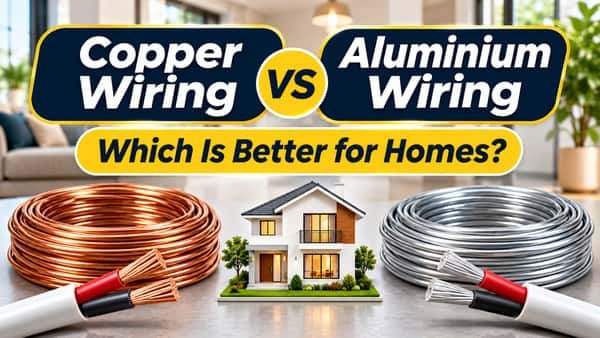
Copper vs Aluminium Wiring: Quick Comparison
| Feature | Copper Wiring | Aluminium Wiring |
|---|---|---|
| Electrical conductivity | Higher | Lower than copper |
| Conductor size for comparable duty | Generally smaller | Generally larger |
| Weight | Heavier | Much lighter |
| Connection requirements | Straightforward with compatible equipment | Requires greater attention to compatible terminations |
| Mechanical strength | Higher | Lower |
| Flexibility for household installation | Generally good | Depends on conductor/cable |
| Cost of conductor | Usually higher | Usually lower |
| Common residential suitability | Excellent | Application-dependent |
| Space efficiency | Better | Requires larger conductor for comparable resistance |
| Best suited to | Internal home circuits | Larger properly engineered applications |
What Is Copper Wiring?
Copper conductors are extensively used in residential electrical installations.
In homes, insulated copper wires or cables connect distribution boards to lighting points, sockets, appliances and other loads.
Copper is popular because it combines useful electrical conductivity with good mechanical characteristics.
Depending on the application, residential conductors may be solid or made from multiple strands. The insulation, voltage rating, conductor cross-sectional area and cable construction must all match the intended circuit.
The conductor material is therefore only one part of a safe wiring system.
What Is Aluminium Wiring?
Aluminium is another electrically conductive metal widely used in the power sector.
Its low density is a major advantage. Aluminium conductors can be much lighter than equivalent copper solutions, making the material valuable in applications where conductor weight and economics matter.
However, aluminium has lower electrical conductivity than copper. Consequently, an aluminium conductor generally needs a larger cross-sectional area than copper to achieve comparable electrical resistance.
Its connections also need to be engineered for aluminium rather than treated exactly like copper connections.
That distinction is especially important when evaluating its suitability inside a house.
1. Electrical Conductivity
Winner: Copper
Copper conducts electricity better than aluminium for the same conductor cross-sectional area.
In practical terms, this means a copper conductor can provide lower resistance than an aluminium conductor of the same size.
Aluminium can compensate through a larger conductor cross-section, but that affects:
- Cable dimensions
- Conduit requirements
- Terminals
- Installation
- Overall system design
This is why comparing a copper and aluminium wire only by nominal size is inappropriate.
The circuit must be designed for the actual conductor material.
2. Current-Carrying Capacity
Winner: Copper for compact residential circuits
The safe current-carrying capacity of a cable is not determined solely by whether its conductor is copper or aluminium.
It also depends on factors such as:
- Conductor cross-section
- Insulation
- Ambient temperature
- Installation method
- Number of loaded conductors
- Grouping
- Cable construction
Copper’s higher conductivity allows designers to achieve required electrical performance with a smaller conductor than aluminium in many comparable situations.
This is valuable in homes where several circuits may need to pass through conduits.
Cable sizing should nevertheless be based on applicable electrical design requirements rather than a generic rule such as “use this size for every socket.”
3. Connections and Terminations
Winner: Copper for typical household convenience
Connections are one of the most important differences between the materials.
Aluminium and copper have different mechanical and thermal characteristics. Aluminium also forms an oxide layer on its surface.
Equipment used with aluminium conductors therefore needs to be suitable for aluminium, and terminations must be made using the correct methods and compatible components.
Using inappropriate terminals or poor workmanship can create unreliable connections.
Copper is widely compatible with residential switches, sockets, distribution equipment and other accessories when the equipment is specified for the conductor being used.
For typical home wiring, this simplifies installation.
4. Mechanical Strength
Winner: Copper
Copper generally provides greater mechanical strength and durability for a given conductor size.
This can be useful during installation, particularly where conductors are pulled through conduits and terminated at numerous switches and sockets.
Any conductor can be damaged by poor handling, excessive bending or incorrect stripping.
Electrical installers should use appropriate tools and follow the cable manufacturer’s bending and installation requirements.
Good workmanship remains important regardless of conductor material.
5. Weight
Winner: Aluminium
Aluminium is significantly lighter than copper.
This is one reason it is valuable in many larger electrical distribution and transmission applications.
The weight advantage can also become relevant when dealing with large conductor sizes.
For the relatively short and smaller branch circuits found inside a typical home, however, conductor weight is usually less important than factors such as connection compatibility, conduit space and installation convenience.
6. Cost
Winner: Aluminium for raw conductor economics
Aluminium generally offers a material-cost advantage compared with copper.
This can become substantial in projects using large quantities of large conductors.
But homeowners should not compare the metals only on the price of the conductor.
A proper comparison should include:
- Required conductor size
- Cable construction
- Conduit size
- Termination hardware
- Compatible equipment
- Installation labour
- Long-term inspection requirements
A lower conductor price does not automatically mean the complete electrical installation will be the best value.
For normal residential branch wiring, reliability and compatibility usually deserve greater priority than minimising conductor cost.
7. Space Inside Conduits
Winner: Copper
Because aluminium generally needs a larger cross-sectional area to achieve comparable electrical resistance, the finished cable or conductor arrangement can require more space.
This matters in concealed residential wiring.
Conduits must accommodate the selected wires without excessive crowding and while satisfying applicable installation requirements.
Planning adequate conduit size during construction also makes future maintenance or rewiring easier.
Trying to compensate for an undersized conduit by forcing additional wires through it is poor practice regardless of conductor material.
8. Heat and Electrical Safety
Winner: Properly designed installation
Neither metal should be described as automatically “safe” or “unsafe” without considering the electrical system around it.
Excessive heating can result from issues such as:
- Overloading
- Loose connections
- Incorrect cable sizing
- Poor-quality accessories
- Improper terminations
- Inadequate protective devices
Copper’s conductivity and common compatibility with household equipment make it a practical choice for residential circuits.
But copper wiring can still become dangerous when incorrectly designed or installed.
Electrical safety depends on the complete system: conductor, insulation, earthing, circuit protection, terminations and workmanship.
9. Residential Applications
Winner: Copper
For typical internal home circuits, copper is generally the more practical choice.
These circuits can include:
- Lighting
- General sockets
- Kitchen appliances
- Air conditioners
- Water heaters
- Washing machines
- Other dedicated loads
Different appliances can require different circuit designs and protective arrangements.
Large supply conductors and specialised applications should be evaluated separately because aluminium may be technically and economically appropriate when the complete system is designed for it.
Do not assume that the conductor material used in one part of the electrical network should automatically be used throughout the house.
10. Standards and Product Quality
Winner: Both when correctly specified
Indian electrical installations should use cables and components conforming to the standards applicable to their particular product and application.
For example, IS 694 covers PVC-insulated cables for working voltages up to and including 1,100 V within its scope.
However, seeing an IS number on a quotation is not enough.
Homeowners should ask the electrician or contractor to specify:
- Manufacturer
- Conductor material
- Nominal conductor area
- Cable type
- Voltage rating
- Applicable standard
- Circuit application
Where required, choose appropriately certified products from established manufacturers.
Electrical cable is not an appropriate area for saving money through unverified products.
Copper or Aluminium: Which Should You Choose for a Home?
For typical concealed internal household wiring, copper is generally the better choice.
Its main advantages are:
- Higher conductivity
- Smaller conductor size for comparable resistance
- Strong mechanical properties
- Convenient household terminations
- Broad use in residential wiring
Aluminium should not be dismissed as a poor electrical material. It has important applications, particularly where larger conductors, weight and economics make it advantageous.
The key is that an aluminium circuit must be designed as an aluminium system, using the correct conductor size, connectors and equipment.
It should never be treated as a direct same-size replacement for copper.
What Should Homeowners Check Before Wiring a House?
Instead of asking the electrician only which wire brand will be used, request a circuit schedule.
The electrical design should consider major loads such as:
- Air conditioners
- Water heaters
- Kitchen appliances
- Washing machine
- Pumps
- General sockets
- Lighting
The appropriate conductor size and protective device depend on the circuit and installation conditions.
Also ensure that proper earthing and suitable protective devices are part of the electrical design.
Most importantly, do not attempt to modify household mains wiring based on an online comparison. Electrical work can cause serious shock or fire hazards when performed incorrectly. Use a qualified electrician or electrical professional for design, installation, testing and alterations.
FAQs
Q1. Which is better for home wiring, copper or aluminium?
A. Copper is generally preferred for typical internal residential wiring because of its higher conductivity, mechanical properties and convenient compatibility with common household electrical equipment.
Q2. Is aluminium wiring cheaper than copper wiring?
A. Aluminium conductors generally have a material-cost advantage, but a proper comparison must also account for the larger conductor size that may be required, compatible terminals, equipment and installation.
Q3. Can aluminium wire replace copper wire of the same size?
A. No. Aluminium and copper have different electrical properties, so they should not be substituted on a same-size basis without proper electrical design. A qualified professional should determine the required conductor and protective equipment.
Q4. Why is copper commonly used for household wiring?
A. Copper provides high electrical conductivity, useful mechanical strength and convenient terminations for many residential applications. It can also provide the required electrical performance using a smaller conductor than aluminium in comparable situations.
Q5. Is aluminium electrical wiring unsafe?
A. Aluminium is not inherently unsafe when a system is correctly engineered with suitable conductors, connectors, equipment and installation practices. Problems can arise when conductor sizing, terminations or components are inappropriate, which is why residential electrical work should be handled by qualified professionals.