The biggest difference between a smart lock and a traditional lock becomes obvious when someone needs access but does not have the physical key. With a traditional system, the solution usually involves finding a spare key or arranging physical access. A smart lock may provide alternatives such as a PIN, fingerprint, card or authorised app access, depending on the model.
That convenience is attractive, but it introduces batteries, electronics, software and sometimes internet connectivity into something that was previously almost entirely mechanical.
For most homeowners, a good-quality traditional lock is the simpler choice for reliability and low maintenance, while a smart door lock is better when keyless access, multiple-user management and convenience are priorities. Security depends heavily on the quality of the complete door, lock and installation—not simply whether the lock is “smart.”
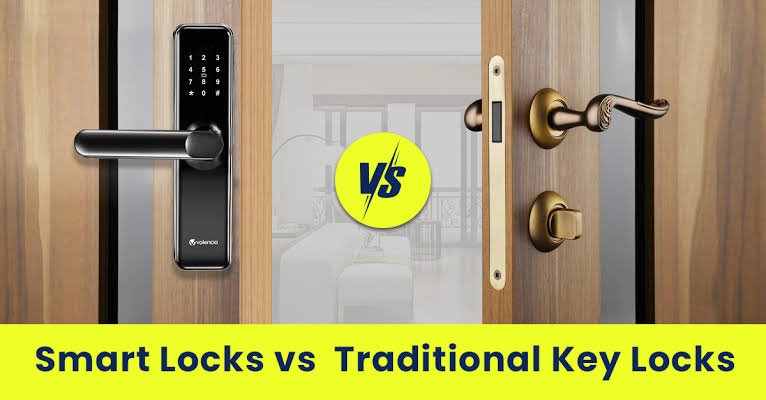
Smart Door Lock vs Traditional Door Lock: Quick Comparison
| Feature | Smart Door Lock | Traditional Door Lock |
|---|---|---|
| Physical key required | Often optional | Usually yes |
| PIN/fingerprint access | Common | No |
| Remote features | Available on some models | No |
| Access management | Excellent | Limited |
| Power requirement | Usually battery-powered | None for basic mechanical lock |
| Maintenance | Higher | Lower |
| Installation | Can be more complex | Generally simpler |
| Digital privacy concerns | Possible on connected models | Minimal |
| User convenience | Excellent | Basic |
| Best for | Keyless, managed access | Simplicity and reliability |
What Is a Smart Door Lock?
A smart lock is an electronic locking system that can provide one or more alternatives to a conventional physical key.
Depending on the model, access methods may include:
- Fingerprint
- PIN
- RFID card
- Smartphone app
- Physical backup key
- Other manufacturer-supported credentials
Some connected models also provide features such as access records, temporary credentials and remote management.
However, “smart lock” covers a wide range of products.
A basic keypad lock and a premium connected mortise lock have very different capabilities, construction and security characteristics.
The exact model matters more than the smart-lock label.
What Is a Traditional Door Lock?
A traditional door lock relies primarily on mechanical components and a physical key.
Common residential systems include:
- Mortise locks
- Deadbolts
- Rim locks
- Cylindrical locks
- Padlocks for appropriate applications
Mechanical locks have been used for generations because they are straightforward, widely understood and do not require batteries, apps or software.
Modern high-quality mechanical locks can also incorporate sophisticated cylinders and robust locking mechanisms.
1. Everyday Convenience
Winner: Smart lock
Convenience is the strongest argument for a smart door lock.
You may not need to search your bag or pockets for a key every time you arrive home.
Depending on the model, you can unlock the door using a fingerprint or PIN.
This can be especially useful for households where several family members regularly enter at different times.
Instead of producing multiple physical keys, authorised users can receive individual credentials where the system supports them.
Traditional locks are simple but require you to carry the correct key.
2. Reliability
Winner: Traditional lock for simplicity
A basic mechanical lock does not depend on:
- Batteries
- Wi-Fi
- Bluetooth
- Software
- Apps
- Electronic sensors
This simplicity is valuable.
A quality mechanical lock can continue functioning without requiring firmware updates or battery replacement.
Smart locks contain additional electronic components, increasing the number of things that potentially require attention.
That does not mean smart locks are inherently unreliable. Good products can provide years of service.
But a smart lock should be selected with a clear understanding of what happens if its electronic features become unavailable.
3. Power Failure and Battery Life
Winner: Traditional lock
Traditional mechanical locks require no electrical power for normal operation.
Smart locks generally use batteries.
Manufacturers may provide low-battery warnings, and some models offer emergency power options or mechanical backup access.
The exact arrangement varies.
Before purchasing a smart lock, ask:
- What happens when the battery becomes low?
- How is the warning provided?
- Is there emergency power access?
- Is a mechanical backup key available?
- How is the lock opened if the electronics fail?
Do not wait until a battery is completely exhausted to find out how emergency access works.
4. Multiple Users
Winner: Smart lock
Smart locks can be particularly convenient in households with several authorised users.
Instead of distributing several physical keys, supported systems may allow different fingerprints, PINs or other credentials.
Some products can also provide temporary access.
This can be useful when authorised entry is needed for a limited period without permanently distributing a key.
Traditional locks can accommodate multiple people by making duplicate keys, but removing someone’s access can be more complicated.
You may need to recover the key or change/rekey the relevant cylinder or lock.
5. Lost Keys
Winner: Smart lock
Losing a traditional house key can create uncertainty.
Even if you have a spare, you may not know who could eventually find the lost key.
Depending on the circumstances, replacing or rekeying the lock may be appropriate.
A smart lock using individually managed credentials can simplify this issue.
A compromised PIN or supported digital credential may be changed without replacing the entire physical lock.
However, any backup physical key supplied with the smart lock still needs to be protected.
6. Security
Winner: Product and installation dependent
Neither technology is automatically more secure.
A cheap smart lock with weak physical construction does not become highly secure because it includes a fingerprint sensor.
Similarly, a poorly made traditional lock does not become secure simply because it has no electronics.
Physical security depends on the complete entrance system, including:
- Door material and construction
- Door frame
- Lock body
- Cylinder
- Strike/locking points
- Hinges
- Installation quality
A strong lock installed on a weak or damaged door cannot provide the protection expected from the lock specification alone.
Evaluate the entire door assembly.
7. Digital Security and Privacy
Winner: Traditional lock
A conventional mechanical lock has very little digital privacy exposure because it does not connect to an app, account or network.
Connected smart locks introduce additional considerations.
Depending on the product, information may be processed relating to:
- User accounts
- Access credentials
- Entry history
- Device activity
If you choose a connected lock, use the manufacturer’s supported security features, protect the associated account with a strong unique password and keep software or firmware updated where updates are provided.
Also check what happens to app functionality if the manufacturer eventually stops supporting the product.
8. Fingerprint Access
Winner: Smart lock
Fingerprint access can be extremely convenient.
You do not need to remember a PIN or carry a key for normal entry.
But fingerprint performance varies.
Recognition can potentially be affected by factors such as:
- Sensor quality
- Dirty sensor surface
- Finger condition
- Incorrect registration
For this reason, a smart lock should ideally provide more than one legitimate access method.
A household should understand the manufacturer’s backup procedure before relying on fingerprint access as its primary method.
9. Installation
Winner: Traditional lock, generally
Traditional locks are widely understood by locksmiths and door installers.
Replacement parts and compatible hardware may also be easier to obtain.
Smart-lock installation can be more demanding because the device must physically fit the door.
Before buying, check compatibility with:
- Door thickness
- Existing cut-outs
- Door material
- Opening direction
- Frame
- Mortise dimensions, where applicable
Buying a smart lock first and checking door compatibility afterwards can lead to unnecessary modification.
Professional installation is advisable for the main entrance.
10. Maintenance
Winner: Traditional lock
Mechanical locks generally require relatively little attention beyond appropriate care and repairs when wear develops.
Smart locks add battery replacement and electronic maintenance.
Connected products may also require:
- App updates
- Firmware updates
- Account management
- User credential management
The additional maintenance is usually manageable, but buyers should recognise that a smart lock is both door hardware and an electronic device.
11. Cost
Winner: Traditional lock
Traditional locks are available across a very wide price range, but basic good-quality mechanical options are generally less expensive than feature-rich smart locks.
Smart-lock prices can increase with features such as:
- Fingerprint recognition
- Keypad access
- RFID
- App connectivity
- Access logs
- Premium lock bodies
Installation may also add to the total cost.
Instead of paying for the longest feature list, choose the features that will actually be useful in your household.
12. Rental Homes
Winner: Traditional lock, generally
Tenants may prefer a conventional lock because it is simpler and may require fewer modifications to the owner’s door.
Installing a smart mortise lock can involve changing existing door hardware.
Permission may therefore be required.
Some smart products are easier to retrofit than others, but compatibility must be checked carefully.
Homeowners planning to install smart locks on rental properties should also think about how access credentials will be reset between occupants.
Smart Lock or Traditional Lock: Which Should You Choose?
Choose a smart door lock if:
- You frequently forget or dislike carrying keys.
- Several family members need independent access.
- Fingerprint or PIN entry is useful.
- You want manageable user credentials.
- You are comfortable maintaining batteries and electronics.
- The model is compatible with your door.
Choose a traditional door lock if:
- Mechanical simplicity is your priority.
- You do not need keyless entry.
- You want minimal maintenance.
- Lower initial cost matters.
- You prefer a system without apps or electronic dependencies.
For many Indian homes, a high-quality mechanical lock remains a dependable and practical solution.
For households where multiple people regularly come and go, a well-designed smart lock can provide a meaningful improvement in convenience.
A Hybrid Approach Can Make Sense
The choice does not always need to be completely digital or completely mechanical.
Many smart locks include a mechanical backup method in addition to electronic access.
Another option is to use smart access as part of a layered entrance-security arrangement while retaining suitable mechanical security where appropriate.
Whatever you choose, do not judge home security by the lock alone.
Check the condition and strength of:
- Main door
- Frame
- Hinges
- Locking points
- Supporting hardware
For smart locks, also confirm battery-warning behaviour, emergency-access procedures, warranty and local after-sales support before purchasing.
The best lock is one that combines suitable physical security with an access method your household can use reliably every day.
FAQs
Q1. Which is better, a smart lock or traditional lock?
A. A smart lock is better for keyless convenience and managing multiple users, while a traditional lock is better for mechanical simplicity, low maintenance and freedom from battery or software dependencies.
Q2. What happens if a smart lock battery dies?
A. The procedure depends on the model. Many smart locks provide low-battery warnings and may offer emergency power or mechanical backup access. Check the exact emergency-access procedure before installation.
Q3. Are fingerprint door locks reliable?
A. Good-quality fingerprint locks can provide convenient everyday access, but recognition performance varies by product and conditions. A suitable backup access method is important.
Q4. Does a smart lock work without Wi-Fi?
A. Some smart locks can perform basic local functions such as fingerprint or PIN unlocking without Wi-Fi, while remote features may require connectivity. The exact behaviour depends on the model.
Q5. Is a smart lock worth buying for a home?
A. It can be worthwhile when keyless entry, multiple-user access or easier credential management will be used regularly. If those features are unnecessary, a good-quality traditional lock may provide a simpler and more economical solution.