A water-supply pipe may remain hidden inside a wall or shaft for years, so choosing the wrong material can create a much bigger problem than the initial price difference suggests. The key question when comparing PVC and CPVC is not simply which material is stronger—it is whether the pipeline will carry only cold water or will also be exposed to hot water.
PVC is widely used in water-related piping because it is lightweight, corrosion-resistant and economical. CPVC is a modified form of PVC designed to tolerate higher temperatures, making it more suitable for domestic hot-and-cold water distribution.
For most Indian homes, properly specified PVC pipes can be an economical choice for cold-water supply, while CPVC is the more practical option for internal plumbing that needs to handle both hot and cold water.
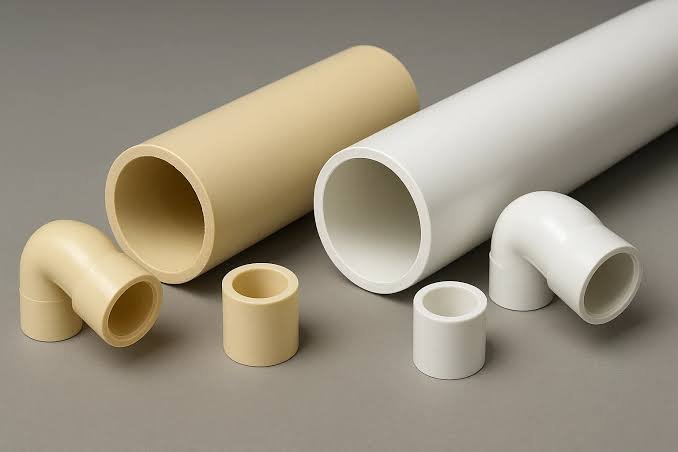
PVC vs CPVC Pipes: Quick Comparison
| Feature | PVC | CPVC |
|---|---|---|
| Full form | Polyvinyl Chloride | Chlorinated Polyvinyl Chloride |
| Cold-water supply | Yes, when correctly specified | Yes |
| Hot-water supply | Generally not suitable | Yes |
| Temperature resistance | Lower | Higher |
| Corrosion | Does not rust | Does not rust |
| Weight | Lightweight | Lightweight |
| Installation | Relatively simple | Relatively simple |
| Typical cost | Lower | Higher |
| Common home use | Cold-water applications | Hot and cold internal plumbing |
| Main advantage | Economy | Temperature versatility |
What Is PVC Pipe?
PVC stands for polyvinyl chloride, a widely used thermoplastic material.
In rigid water-supply applications, homeowners will commonly encounter unplasticized PVC, also known as PVC-U or UPVC.
This distinction matters because “PVC” is a broad material description covering products designed for very different purposes.
A PVC drainage pipe and a pressure-rated PVC potable-water pipe are not interchangeable simply because they are manufactured from a similar base material.
For potable water supplies in India, BIS publishes IS 4985:2021 – Unplasticized PVC Pipes for Potable Water Supplies — Specification (Fourth Revision). The standard superseded IS 4985:2000.
So when PVC is being considered for a water-supply line, homeowners should verify the actual product specification rather than relying only on the word “PVC.”
What Is CPVC Pipe?
CPVC stands for chlorinated polyvinyl chloride.
It is produced by further chlorinating PVC resin, changing the material’s characteristics and improving its ability to handle elevated temperatures.
This is particularly useful inside homes.
Bathrooms and kitchens may have cold-water lines alongside hot-water pipes connected to geysers or other water-heating systems. Instead of using one material for cold water and another for hot water, a properly specified CPVC system can serve both.
In India, IS 15778:2007 covers CPVC pipes for potable hot-and-cold water distribution. The standard specifies pipes intended for water service at temperatures up to and including 82°C.
1. Cold-Water Supply
Winner: Both
For cold potable water, both materials can work when the correct water-supply product is selected.
PVC-U has been widely used for potable-water applications and offers a combination of corrosion resistance, low weight and affordability.
CPVC can also carry cold water.
If a house has only a cold-water line—for example, from a storage tank to an outdoor tap—using an appropriately rated PVC-U water-supply pipe may be more economical.
Inside a bathroom containing both hot and cold plumbing, however, using CPVC for the distribution system may simplify material selection.
The important point is to use pipes with the appropriate pressure and potable-water specifications.
2. Hot-Water Supply
Winner: CPVC
This is the decisive difference.
Conventional PVC water-supply piping should not be selected as a substitute for a system designed for hot water.
CPVC is specifically designed to tolerate higher temperatures. India’s IS 15778 covers CPVC for potable hot-and-cold water distribution, with service temperatures up to and including 82°C.
This makes CPVC suitable for typical domestic hot-water plumbing when the selected pipe, fittings and installation comply with the required specifications.
For a geyser connection, CPVC is therefore the clear choice between these two materials.
3. Temperature Resistance
Winner: CPVC
CPVC’s additional chlorination changes its temperature-related properties.
BIS specifications for CPVC include requirements concerning thermal stability and softening characteristics in addition to dimensional and hydrostatic performance.
However, homeowners should not interpret a material’s laboratory characteristics as permission to operate it at any temperature.
The pipe manufacturer’s stated pressure-temperature rating must be followed.
As temperature rises, the pressure capacity of plastic piping systems can change. Therefore, pipe size and pressure class need to be selected for actual operating conditions.
4. Corrosion Resistance
Winner: Tie
PVC and CPVC share an important advantage: neither rusts like ordinary steel.
This makes both useful in water-supply installations where corrosion is a concern.
Their internal surfaces are also relatively smooth, which can help maintain flow without rust accumulation inside the pipe.
But corrosion resistance does not mean unlimited chemical resistance.
Certain chemicals, sealants, lubricants and other substances can be incompatible with particular plastic piping systems. Installers should use materials approved or recommended by the pipe manufacturer.
5. Pressure Handling
Winner: Depends on specification
It is incorrect to say that CPVC is always a higher-pressure pipe simply because it is suitable for hotter water.
Pressure capacity depends on several factors:
- Pipe diameter
- Wall thickness
- Pressure class
- SDR
- Water temperature
- Manufacturer
- Applicable standard
A correctly specified PVC pressure pipe may handle its intended cold-water pressure very effectively.
Likewise, CPVC needs to be selected according to the pressure and temperature of the system.
This becomes particularly important in houses using pressure pumps or multi-storey water-distribution systems.
Ask for the actual rated working conditions rather than selecting a pipe only by diameter.
6. Installation
Winner: Tie
Both PVC and CPVC can be relatively quick to install compared with many traditional metallic systems.
Common systems use solvent-cement joining, where compatible pipe and fittings are chemically joined according to a specified procedure.
Good installation requires:
- Square pipe cuts
- Clean mating surfaces
- Correct fittings
- Compatible solvent cement
- Proper insertion
- Appropriate curing time
- Correct pipe supports
- Pressure testing
CPVC hot-water installations also need appropriate consideration for thermal expansion and contraction.
A high-quality pipe with badly made joints can still develop leaks, so workmanship matters as much as the brand.
7. Durability
Winner: Both when correctly used
There is no useful universal answer such as “PVC lasts X years and CPVC lasts Y years” for every house.
Service life depends on operating pressure, temperature, water conditions, installation, exposure and product quality.
PVC can provide durable service when used for an appropriate cold-water application.
CPVC is better suited when the system regularly experiences the higher temperatures associated with domestic hot-water supply.
Using a material outside its intended conditions can reduce reliability regardless of how reputable the manufacturer is.
For concealed plumbing, correct material selection becomes especially important because future repairs may require opening walls or floors.
8. Cost
Winner: PVC
PVC water-supply pipes are generally the more economical option.
CPVC usually costs more because of its material characteristics and suitability for hot-water distribution.
But comparing only the price per metre can be misleading.
A complete plumbing quotation includes:
- Pipes
- Fittings
- Elbows and tees
- Valves
- Solvent cement
- Pipe supports
- Labour
- Testing
If hot water is required, choosing cheaper PVC instead of an appropriately specified hot-water system is not a meaningful saving.
For cold-water-only installations, PVC can offer better value.
9. Outdoor Use
Winner: Depends on product and protection
Outdoor plumbing introduces additional factors such as sunlight, physical impact and temperature changes.
Plastic piping exposed to direct sunlight should be installed according to manufacturer recommendations. Some applications may require protection from prolonged UV exposure.
Pipe supports also matter because long exposed runs can move or sag when poorly installed.
For underground cold-water distribution, properly specified PVC pressure pipe can be highly practical.
For exposed or hot-water CPVC lines, follow the manufacturer’s requirements for support, insulation and environmental protection.
10. Drinking-Water Supply
Winner: Both when certified for the application
Material names alone do not determine whether a pipe should carry drinking water.
The actual product must be intended for potable-water use.
BIS IS 4985:2021 specifically covers unplasticized PVC pipes for potable water supplies.
For CPVC, IS 15778:2007 covers pipes for potable hot-and-cold water distribution.
Homeowners should therefore check markings on the pipe itself and purchase products from reliable manufacturers and sellers.
PVC or CPVC: Which Should You Choose?
For a typical home, the choice can be simplified according to application.
Choose PVC when:
- Only cold water will pass through the pipe.
- The pipe is specifically rated for potable water supply.
- The required pressure rating is available.
- Cost is an important consideration.
- The application suits the manufacturer’s specifications.
Choose CPVC when:
- Hot water will pass through the line.
- The same piping material is desired for hot and cold internal plumbing.
- The pipe will connect to bathroom or kitchen hot-water systems.
- Higher temperature resistance is required.
A house does not necessarily need one pipe material everywhere.
For example, appropriately specified PVC-U could be used for certain cold-water distribution applications while CPVC is used for internal hot-and-cold plumbing.
Other systems may also use different materials for drainage and sewerage.
Check the IS Standard Before Buying
One of the easiest mistakes during construction is choosing pipes according to colour.
Colour should not replace technical specifications.
Before purchasing water-supply pipes, check details such as:
- IS standard
- Manufacturer
- Pipe diameter
- Pressure class or SDR
- Intended application
- Potable-water suitability
- Compatible fittings
- Recommended solvent cement
For rigid PVC-U potable-water pipes, check the applicable IS 4985:2021 specification. For CPVC hot-and-cold potable-water distribution, check IS 15778:2007 and its applicable amendments.
This becomes particularly important for concealed plumbing, where replacing an unsuitable product later can cost far more than selecting the right pipe initially.
FAQs
Q1. Which is better for water supply, PVC or CPVC?
A. Both can be suitable for cold-water supply when the correct potable-water product is used. CPVC is more versatile for residential plumbing because it can also handle domestic hot-water distribution.
Q2. Can PVC pipe be used for drinking water?
A. Properly specified PVC-U pipes manufactured for potable-water supply can be used for this purpose. In India, IS 4985:2021 covers unplasticized PVC pipes for potable water supplies.
Q3. Is CPVC suitable for geyser water?
A. CPVC is designed for hot-and-cold potable-water distribution. IS 15778 specifies CPVC pipes for water service at temperatures up to and including 82°C, subject to the appropriate system specification.
Q4. Is CPVC more expensive than PVC?
A. CPVC generally costs more than basic PVC water-supply piping. Actual project cost depends on pipe size, pressure rating, fittings, brand, labour and the overall plumbing layout.
Q5. Can PVC and CPVC use the same solvent cement?
A. Do not assume that they can. Use the joining products and procedure specified for the particular piping system by the manufacturer. Incorrect or incompatible solvent cement can compromise a joint.