A walk-in wardrobe does something a regular wardrobe cannot: it turns storage into a separate usable space. But that advantage comes at a price—not just in money, but in floor area. In a compact bedroom, sacrificing several square feet to create a walk-in wardrobe may actually make the overall room less comfortable.
A regular wardrobe takes the opposite approach. It keeps storage against a wall, leaving more of the room available for the bed, circulation and other furniture.
For most Indian apartments, a well-designed regular wardrobe is the more space-efficient and economical choice. A walk-in wardrobe becomes worthwhile when the home has sufficient floor area, substantial storage requirements and a layout that allows a dedicated dressing zone without compromising the bedroom.
Walk-In Wardrobe vs Regular Wardrobe: Quick Comparison
| Feature | Walk-In Wardrobe | Regular Wardrobe |
|---|---|---|
| Space required | High | Low to moderate |
| Storage capacity | Excellent | Good to excellent |
| Walk-in access | Yes | No |
| Dressing area | Can be integrated | Usually separate |
| Customisation | Excellent | Excellent |
| Privacy | Better | Limited |
| Lighting requirements | More important | Simpler |
| Cost | Higher | Lower |
| Small bedrooms | Usually impractical | Excellent |
| Best for | Large bedrooms/luxury homes | Most apartments and houses |
What Is a Walk-In Wardrobe?
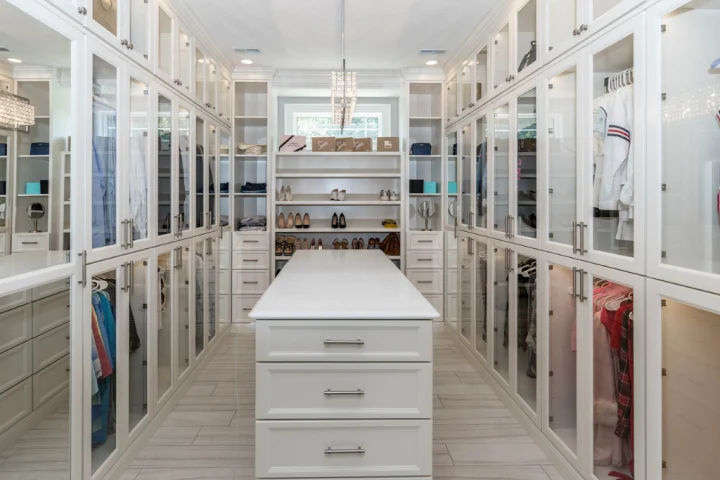
A walk-in wardrobe is a dedicated storage area large enough for a person to enter.
It may be a completely separate room or a section of a large bedroom divided using walls, partitions, glass or cabinetry.
Storage can be installed on:
- One wall
- Two parallel walls
- Three sides
- A U-shaped layout
- An L-shaped layout
Larger walk-ins may also include a dressing mirror, drawers, seating or a central storage island.
The main distinction is that circulation space exists inside the wardrobe area.
That makes it fundamentally different from simply installing a very large wall wardrobe.
What Is a Regular Wardrobe?
A regular wardrobe stores clothes within a cabinet accessed from the bedroom.
It can be:
- Built-in
- Freestanding
- Hinged
- Sliding
- Floor-to-ceiling
- Modular
A well-designed regular wardrobe can still provide extensive storage.
Modern versions can incorporate hanging sections, drawers, shoe storage, trouser racks, accessory organisers and upper cabinets without requiring a separate room.
This makes them suitable for a much broader range of bedroom sizes.
1. Floor-Space Requirement
Winner: Regular wardrobe
This is the most important difference.
A regular wardrobe mainly requires the depth of the cabinet plus enough space in front for comfortable access.
A walk-in wardrobe requires both storage depth and circulation space inside the wardrobe.
If storage is installed on two opposite walls, the room must accommodate both sets of cabinets plus a usable passage between them.
Creating a walk-in in a bedroom that is already small can therefore be counterproductive.
You may gain an impressive dressing area but lose valuable space around the bed.
For compact apartments, a full-height regular wardrobe is usually the more efficient use of floor area.
2. Storage Capacity
Winner: Walk-in wardrobe, when sufficient space is available
A properly planned walk-in can provide substantial storage because multiple walls can be used simultaneously.
Separate sections can be created for:
- Shirts
- Trousers
- Dresses
- Sarees
- Suits
- Shoes
- Bags
- Accessories
- Jewellery
- Luggage
- Seasonal clothing
Couples can also divide the wardrobe into individual zones.
However, a poorly planned walk-in is not automatically more spacious than a wall wardrobe.
Corners, doorways and circulation passages consume space.
In some rooms, a large floor-to-ceiling regular wardrobe can actually provide more usable storage per square foot.
3. Organisation
Winner: Walk-in wardrobe
A walk-in provides more freedom to divide belongings into categories.
Because more wall area is available, individual storage sections do not need to perform several functions simultaneously.
You might dedicate one wall to hanging clothes, another to folded clothes and a third to shoes and accessories.
Open shelves can also make frequently used items immediately visible.
Regular wardrobes require more careful allocation because everything needs to fit inside a comparatively narrow cabinet.
Good internal accessories can reduce this disadvantage substantially.
4. Dressing Experience
Winner: Walk-in wardrobe
This is where a walk-in offers something genuinely different rather than simply “more storage.”
A large enough walk-in can function as a dressing room.
It may include:
- Full-length mirror
- Dressing counter
- Seating
- Jewellery storage
- Accessory drawers
- Integrated lighting
Clothes and accessories can be selected in the same space without spreading items across the bedroom.
For homeowners who value a dedicated dressing area, this can be a major lifestyle advantage.
A regular wardrobe provides storage but does not create the same separate experience.
5. Small Bedrooms
Winner: Regular wardrobe
In a small bedroom, creating an enclosed walk-in generally consumes too much usable floor area.
A regular wardrobe positioned against one wall makes more sense.
A floor-to-ceiling design can use vertical space effectively while leaving the centre of the room open.
Sliding shutters can further help when clearance between the wardrobe and bed is limited.
Instead of forcing a walk-in into a compact room, it is often better to invest in a better internal wardrobe layout.
Pull-out accessories, adjustable shelves and efficient upper storage can significantly increase capacity without increasing the footprint.
6. Privacy
Winner: Walk-in wardrobe
A separate walk-in provides a private area for dressing and storing personal belongings.
This can be particularly useful in a shared bedroom.
Some layouts connect the walk-in wardrobe with an attached bathroom, creating a combined dressing zone.
However, this needs careful planning.
A wardrobe located close to a bathroom should be protected from excessive humidity and any potential water leakage.
Good ventilation becomes particularly important where the dressing area is enclosed.
7. Lighting and Ventilation
Winner: Regular wardrobe for simplicity
A regular wardrobe relies mainly on the bedroom’s existing lighting, although internal LED lighting can be added.
A walk-in needs its own lighting plan.
Deep shelves and hanging clothes can create shadows, so one central ceiling light may not be sufficient.
Possible lighting includes:
- Ceiling lights
- Recessed lights
- Wardrobe LEDs
- Sensor-operated lights
- Mirror lighting
Ventilation also deserves attention.
A completely enclosed wardrobe without adequate airflow can develop musty smells, particularly in humid conditions.
If a walk-in is located near an attached bathroom, controlling moisture becomes even more important.
8. Cleaning and Maintenance
Winner: Regular wardrobe
A regular wardrobe has a relatively small storage footprint to clean.
A walk-in behaves more like another small room.
It contains additional:
- Floor area
- Shelves
- Drawers
- Corners
- Lighting
- Mirrors
Open walk-in shelves can also collect dust faster than storage protected behind shutters.
One solution is to use a combination of open and closed storage, keeping frequently used items accessible while protecting less-used clothing behind doors.
9. Cost
Winner: Regular wardrobe
A walk-in wardrobe is usually more expensive because it requires more than cabinets.
Costs can include:
- Additional cabinetry
- Partitions
- Flooring
- Ceiling work
- Electrical points
- Lighting
- Mirrors
- Drawers
- Accessories
- Seating
- Doors
A regular wardrobe can start with a relatively simple configuration and be upgraded according to budget.
However, there is no fixed price difference.
A premium floor-to-ceiling wardrobe with expensive veneer, glass shutters and imported hardware could cost more than a simple open walk-in.
Always compare complete specifications.
10. Property and Design Appeal
Winner: Walk-in wardrobe for luxury appeal
A well-designed walk-in can give a large primary bedroom a premium character.
It creates a clear separation between sleeping and dressing areas and can reduce visible clutter inside the bedroom.
However, homeowners should avoid creating one solely because it is considered a luxury feature.
If the walk-in makes the bedroom noticeably smaller or removes space needed for a study desk, comfortable circulation or another useful function, it may not improve the overall home.
Practical room planning should come before the label.
Which Wardrobe Is Better for Your Home?
Choose a walk-in wardrobe if:
- The bedroom has generous floor space.
- You own a large clothing or accessory collection.
- A dedicated dressing area is important.
- Two people need substantial separate storage.
- You want premium custom organisation.
- The budget allows additional cabinetry and lighting.
Choose a regular wardrobe if:
- Bedroom space is limited.
- Maximum floor-space efficiency matters.
- You live in an apartment.
- Budget is a major consideration.
- You want simpler cleaning and maintenance.
- A well-organised wall wardrobe provides enough storage.
For most urban Indian apartments, a floor-to-ceiling regular wardrobe with carefully planned internal storage provides the better balance of capacity and space efficiency.
A walk-in makes more sense in a large primary bedroom or house where its circulation area does not take space away from essential bedroom functions.
Plan the Internal Layout Before Building Either
A large wardrobe with a poor internal layout can be less useful than a smaller, carefully planned one.
Before construction, make an approximate inventory of what needs to be stored.
Consider separate space for:
- Long hanging clothes
- Short hanging clothes
- Folded clothes
- Sarees
- Shoes
- Bags
- Jewellery and accessories
- Bedding
- Suitcases
Frequently used items should remain easy to reach. Seasonal luggage and extra bedding can occupy higher sections.
For a walk-in wardrobe, also ensure there is comfortable circulation after drawers and cabinet doors are opened. For a regular wardrobe, check that internal drawers align correctly with the external shutters.
Design around what you actually own rather than copying a wardrobe layout from a showroom.
FAQs
Q1. Which is better, a walk-in wardrobe or regular wardrobe?
A. A regular wardrobe is generally better for space efficiency, affordability and smaller bedrooms. A walk-in wardrobe is better when there is sufficient floor area and you want extensive storage combined with a dedicated dressing space.
Q2. Is a walk-in wardrobe worth it?
A. It can be worthwhile in a large bedroom where creating it does not compromise circulation or other essential furniture. In a small room, a well-designed wall wardrobe is usually a more efficient investment.
Q3. Does a walk-in wardrobe provide more storage?
A. Usually, but not automatically. Walk-ins can use several walls for storage, although circulation space and corners also consume floor area. A large floor-to-ceiling regular wardrobe can sometimes provide better storage efficiency per square foot.
Q4. Is a walk-in wardrobe suitable for an apartment?
A. It can work in a large apartment with a spacious primary bedroom or a separate spare room. In compact apartments, a regular built-in wardrobe usually uses the available space more effectively.
Q5. Does a walk-in wardrobe need ventilation?
A. Good airflow is important, particularly in humid conditions or when the wardrobe is close to a bathroom. Proper ventilation and moisture control help protect clothing and reduce musty odours.