A kitchen sink experiences a harsher daily routine than most finishes in a home. Hot cookware reaches it from the stove, heavy utensils are dropped into it, food stains sit on the surface, and water repeatedly dries around the bowl. This is why choosing a sink purely because one looks better in a showroom can lead to disappointment later.
Stainless steel and quartz composite are two very different approaches. Stainless steel is usually the more practical choice for affordability, lighter weight and straightforward maintenance, while a good-quality quartz composite sink is attractive for its solid appearance, quieter operation and resistance to everyday scratches.
Neither wins every category, so the better option depends on how your kitchen is used.
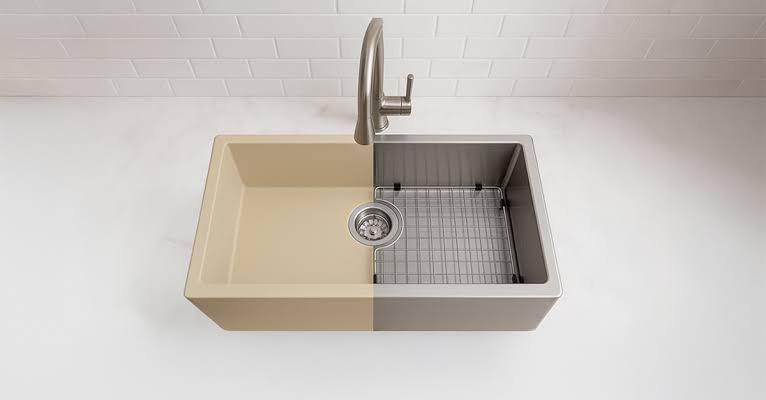
Stainless Steel Sink vs Quartz Sink: Quick Comparison
| Feature | Stainless Steel Sink | Quartz Composite Sink |
|---|---|---|
| Material | Stainless steel | Quartz/mineral particles + resin |
| Weight | Lighter | Heavier |
| Scratch resistance | Can develop visible scratches | Generally good |
| Stain resistance | Very good | Good with proper care |
| Heat resistance | Excellent in normal kitchen use | Good, product-dependent |
| Noise | Can be noisier | Naturally quieter |
| Impact behaviour | May dent | Can chip/crack under severe impact |
| Colour choices | Mostly metallic | Multiple colours |
| Installation | Easier due to lower weight | Needs adequate support |
| Typical cost | Budget to premium | Usually mid-range to premium |
What Is a Stainless Steel Sink?
Stainless steel kitchen sinks are made using corrosion-resistant steel containing chromium and other alloying elements.
For residential sinks, 304-grade stainless steel is a common specification because it offers a useful combination of corrosion resistance, durability and workability.
One important specification is the thickness or gauge of the steel.
A thin, inexpensive sink can feel very different from a heavier premium model even though both are described as stainless steel. Better sinks may also include sound-deadening pads or coatings underneath the bowl to reduce vibration and noise.
Stainless steel’s neutral metallic finish also works with a wide variety of countertop and cabinet styles.
What Is a Quartz Sink?
A sink marketed as a “quartz sink” is normally not carved from a solid piece of natural quartz.
Most are composite sinks made by combining a high proportion of mineral material—often quartz—with a resin binder.
The mixture is moulded into the required sink shape.
This produces a dense surface with a stone-like appearance. Because colour can be incorporated into the material, quartz composite sinks are available in shades such as black, grey, white, beige and brown.
Exact composition varies between manufacturers, so performance claims should always be checked against the particular product rather than assuming every quartz sink is identical.
1. Durability
Winner: Tie, with different strengths
Both materials can be highly durable in a home kitchen.
Stainless steel has an important advantage: it is relatively forgiving.
If a heavy utensil hits the sink, the metal may dent under a sufficiently severe impact, but it is unlikely to behave like a brittle material.
Quartz composite is hard and highly resistant to routine wear. However, severe impact—particularly around edges or corners—can potentially cause chipping or cracking.
For a kitchen where large pressure cookers, cast-iron cookware and heavy utensils are handled frequently, stainless steel’s forgiving nature can be valuable.
For normal household use, a quality quartz composite sink can also provide excellent durability.
2. Scratch Resistance
Winner: Quartz composite
Anyone who has used a stainless steel sink for several years will probably have seen fine surface scratches.
Utensils, metal cookware and abrasive cleaning can mark the finish.
This does not normally affect the sink’s functionality. Over time, numerous fine marks may blend into the overall finish, particularly on brushed stainless steel.
Quartz composite generally provides better resistance to everyday scratching because of its hard mineral-rich surface.
That does not make it impossible to damage. Abrasive cleaners and inappropriate cleaning tools should still be avoided.
If maintaining a relatively uniform appearance is a high priority, quartz has an advantage.
3. Stain Resistance
Winner: Stainless steel, slightly
Stainless steel does not have a porous stone surface that readily absorbs ordinary kitchen spills.
Food residue can normally be removed using routine cleaning.
The more common cosmetic problem is water spotting, particularly in areas with hard water. Mineral deposits can leave visible marks if water is repeatedly allowed to dry on the surface.
Quartz composite is also designed to resist household staining, but lighter colours may show certain residues differently, while dark sinks can make pale mineral deposits more noticeable.
Coffee, tea, spices and strongly coloured foods should be cleaned rather than left sitting for extended periods.
For either material, wiping and rinsing regularly is easier than trying to remove accumulated deposits later.
4. Heat Resistance
Winner: Stainless steel
Stainless steel handles the temperatures normally encountered in a kitchen very well.
Quartz composite sinks also offer useful heat resistance, but the exact limit depends on the manufacturer’s formulation.
This matters because a quartz composite sink contains resin in addition to mineral material.
Manufacturers may specify maximum temperatures and advise against placing extremely hot cookware directly onto the surface.
A simple habit solves much of the problem: use a trivet or allow extremely hot cookware to cool rather than treating the sink as a heat pad.
For households that regularly transfer very hot cookware directly from the stove, stainless steel is the more forgiving option.
5. Noise
Winner: Quartz composite
This is an underrated difference.
Metal can amplify the sound of water, spoons and utensils hitting the bowl. Thin stainless steel sinks can consequently sound noticeably louder.
Higher-quality stainless steel sinks address this using:
- Sound-absorbing pads
- Undercoating
- Thicker material
- Better bowl construction
Quartz composite is naturally dense and tends to absorb vibration better.
As a result, running water and moving utensils generally produce a duller, quieter sound.
For an open-plan kitchen connected directly to a living or dining area, this can make quartz composite particularly appealing.
6. Cleaning and Maintenance
Winner: Stainless steel for simplicity
Neither material requires complicated maintenance, but stainless steel is particularly straightforward.
Routine care generally involves washing the surface with mild detergent and water, rinsing it and occasionally drying it to reduce water spots.
Avoid aggressive abrasive cleaners and steel wool because they can damage the finish.
Quartz composite also benefits from regular gentle cleaning. Strong chemicals and harsh abrasive products should be avoided unless specifically permitted by the manufacturer.
Dark quartz sinks deserve special attention in hard-water areas because white mineral deposits can contrast strongly against the dark surface.
A sink advertised as “maintenance-free” should therefore be treated cautiously. Every kitchen sink needs cleaning.
7. Appearance
Winner: Personal preference
Stainless steel creates a professional, neutral kitchen appearance.
It matches easily with:
- Stainless appliances
- Chrome fittings
- Black countertops
- Granite
- Quartz countertops
- Light or dark cabinetry
Its disadvantage is limited colour choice.
Quartz composite offers much more freedom.
A black sink can visually merge into a dark countertop, while beige, grey or white options can be coordinated with other kitchen finishes.
This makes quartz particularly popular in kitchens where the sink is intended to become part of the overall interior design rather than simply a functional fixture.
8. Weight and Installation
Winner: Stainless steel
Stainless steel is significantly lighter than a mineral composite sink of similar dimensions.
That makes transportation and installation easier.
Quartz composite sinks are heavier and require appropriate countertop support, particularly with undermount installation.
The installer must consider the weight of the sink itself plus the water and utensils it may contain.
Proper clips, brackets, sealants and countertop preparation are important.
This does not make quartz difficult to install, but it makes professional installation more important.
9. Hygiene
Winner: Tie when properly maintained
Both can provide hygienic kitchen surfaces when good-quality products are cleaned correctly.
Stainless steel is widely used in food preparation environments partly because it is durable, easy to clean and corrosion-resistant.
Quartz composite sinks are also manufactured with dense surfaces intended for kitchen use.
Hygiene ultimately depends heavily on routine behaviour.
Food particles left around the drain, dirty sponges and standing residue can create cleanliness problems regardless of whether the sink costs ₹3,000 or ₹30,000.
Pay particular attention to the drain, corners, overflow and joint between the sink and countertop.
10. Price
Winner: Stainless steel
Stainless steel offers a much broader entry-level price range.
Basic models are widely available, while premium handmade or heavy-gauge stainless steel sinks can become considerably more expensive.
Quartz composite generally sits higher in the market because of its material, manufacturing and design positioning.
Actual price depends on:
- Sink dimensions
- Single or double bowl
- Material quality
- Steel thickness
- Composite formulation
- Brand
- Accessories
- Finish
- Installation type
Therefore, compare sinks of similar dimensions and quality rather than assuming every stainless model is cheaper than every quartz model.
Which Sink Is Better for an Indian Kitchen?
Choose a stainless steel sink if:
- You frequently wash heavy cookware.
- You want a practical everyday sink.
- Budget matters.
- You prefer a lightweight sink.
- High heat tolerance is important.
- You do not mind scratches developing over time.
Choose a quartz composite sink if:
- Kitchen appearance is a major priority.
- You want black, grey, beige or another colour.
- You prefer a quieter sink.
- Scratch resistance is important.
- You are comfortable following manufacturer-specific cleaning guidance.
- Your countertop can adequately support the heavier sink.
For a busy kitchen where large pressure cookers and metal utensils are used throughout the day, good-quality stainless steel remains extremely practical.
For a modern modular kitchen where the sink is integrated into the visual design, quartz composite can provide a more premium appearance and quieter experience.
What Should You Check Before Buying?
Material should be only the beginning of the comparison.
For stainless steel, check:
- Steel grade
- Material thickness
- Bowl depth
- Sound-deadening pads
- Undercoating
- Drain position
- Finish
- Warranty
For quartz composite, check:
- Manufacturer
- Material composition
- Maximum recommended temperature
- Cleaning restrictions
- Bowl dimensions
- Installation method
- Warranty
- Availability of matching accessories
Also measure the sink cabinet before ordering. A large sink may physically fit the countertop opening but leave insufficient space for plumbing, a waste disposer or storage underneath.
FAQs
Q1. Which is better, stainless steel or quartz sink?
A. Stainless steel is generally better for affordability, lighter weight and demanding everyday use. Quartz composite is better for colour choice, quieter operation and resistance to routine surface scratches.
Q2. Does a quartz sink crack easily?
A. A quality quartz composite sink should not crack during normal use, but severe impact or poor installation can potentially damage it. Particular care should be taken around edges during transportation and installation.
Q3. Do stainless steel sinks scratch?
A. Yes. Stainless steel can develop fine scratches through normal contact with utensils and cookware. Brushed finishes tend to make everyday wear less noticeable than highly polished surfaces.
Q4. Which sink is easier to clean?
A. Stainless steel is generally very straightforward to clean with mild detergent and water. Quartz composite is also relatively easy to maintain but may require greater attention to the manufacturer’s cleaning instructions, particularly for stains and mineral deposits.
Q5. Which sink is better for a modular kitchen?
A. Either can work well. Stainless steel suits kitchens prioritising practicality and value, while quartz composite is particularly attractive when the sink colour and appearance need to coordinate closely with the countertop and cabinetry.