A ceiling design that looks simple after painting may have been created in two very different ways. One can involve wet material shaped and finished largely at the site, while the other uses factory-manufactured boards fixed to a supporting framework. That construction difference affects installation time, consistency, labour and the type of designs that are practical.
POP and gypsum board are both widely associated with false ceilings in Indian homes, but they should not be treated as interchangeable. Gypsum board is generally better for clean, predictable and faster false-ceiling construction, while POP is particularly useful for decorative mouldings, curves and customised ornamental work.
For many modern apartments, gypsum board is the practical choice for the main ceiling, while POP can be used selectively for decorative detailing.
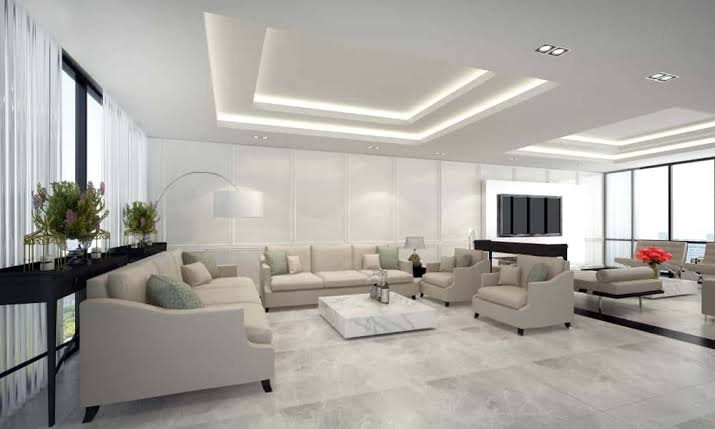
POP Ceiling vs Gypsum Board Ceiling: Quick Comparison
| Feature | POP Ceiling | Gypsum Board Ceiling |
|---|---|---|
| Material form | Powder mixed/prepared on site | Factory-made boards |
| Installation | Labour-intensive | Faster and more systematic |
| Site mess | Higher | Lower |
| Finish quality | Highly workmanship-dependent | More consistent flat surface |
| Curves/details | Excellent | Possible, but system-dependent |
| Large flat ceilings | Good | Excellent |
| Cracking risk | Workmanship-dependent | Joints need correct treatment |
| Repair | Local repairs possible | Damaged sections can be repaired/replaced |
| Material consistency | Depends on mixing/application | Factory-controlled |
| Best for | Decorative designs | Modern false ceilings |
What Is a POP Ceiling?
POP stands for Plaster of Paris.
It is based on gypsum that has been processed into a powder. When mixed with water, the material forms a workable paste that sets and hardens.
In ceiling work, POP is commonly used for decorative elements and surface finishing.
It can be shaped into:
- Cornices
- Borders
- Curves
- Ceiling medallions
- Decorative mouldings
- Custom patterns
Because it is workable before setting, skilled craftsmen can create details that would be difficult to reproduce using standard flat boards alone.
The result, however, depends significantly on workmanship.
What Is a Gypsum Board Ceiling?
Gypsum board is a factory-manufactured panel consisting primarily of a gypsum core with facing material.
The boards are fixed to an appropriately designed metal framework to create the suspended ceiling.
Joints between boards are then treated and finished so that, after painting, the ceiling appears as a continuous surface.
The system is commonly used for:
- Flat ceilings
- Recessed lighting
- Cove designs
- Stepped ceilings
- Curtain pockets
- Service concealment
Different board types are available for different applications, so the correct product should be selected for the room conditions.
1. Installation Speed
Winner: Gypsum board
Gypsum board has a major advantage when large ceiling areas need to be completed efficiently.
The boards arrive in standard manufactured sizes and are fixed to a prepared framework.
The installation follows a relatively systematic process:
- Mark ceiling levels.
- Install the framework.
- Fix gypsum boards.
- Treat joints.
- Finish the surface.
- Apply the final paint system.
POP work involves more wet application and site preparation, particularly when extensive decorative work is required.
This generally makes it more labour-intensive.
For projects with tight completion schedules, gypsum board is often more convenient.
2. Site Cleanliness
Winner: Gypsum board
False-ceiling construction is never completely dust-free, but gypsum-board installation is largely a dry-construction process compared with extensive on-site POP work.
Boards are cut and fixed in position, followed by joint treatment and finishing.
POP requires mixing and manual application at the site, creating greater potential for wet material and waste.
This difference matters particularly during renovation when flooring, doors or other interior finishes may already be installed.
Proper site protection is still necessary for either system.
3. Surface Consistency
Winner: Gypsum board
Factory-manufactured boards provide a consistent base for creating large flat ceiling surfaces.
This makes gypsum board particularly suitable for contemporary interiors where straight lines and smooth planes are important.
POP can also produce an excellent smooth finish, but the result depends much more on the skill of the person mixing and applying the material.
Poor workmanship can result in:
- Uneven surfaces
- Visible waves
- Inconsistent details
- Cracking
- Poor finishing
An experienced POP craftsman can create excellent results, but quality control becomes more dependent on labour.
4. Decorative Designs
Winner: POP
POP’s major advantage is its ability to form custom decorative shapes.
It can be moulded and shaped while workable, making it useful for traditional or ornamental interiors.
Common applications include:
- Decorative ceiling borders
- Floral patterns
- Classical mouldings
- Circular details
- Cornices
Gypsum board can also create impressive ceiling designs, particularly geometric levels, straight coves and clean modern shapes.
However, highly detailed decorative mouldings are often easier to produce using POP or preformed decorative elements.
5. Modern Ceiling Designs
Winner: Gypsum board
For modern apartments, false-ceiling designs are often based on simple geometry rather than extensive ornamentation.
Examples include:
- Floating ceiling effects
- Perimeter coves
- Recessed sections
- Straight-line profiles
- Curtain pockets
- Lighting channels
Gypsum board is particularly well suited to this style.
It provides large, predictable surfaces and integrates easily with planned lighting layouts.
For this reason, it is frequently the practical choice when the design brief is “simple and modern.”
6. Cracks
Winner: Depends on installation quality
Neither system should be described as crack-proof.
POP can crack when there are issues with:
- Mixing
- Application thickness
- Substrate preparation
- Structural movement
- Workmanship
Gypsum-board ceilings have joints between individual boards. If the framework, board fixing or joint treatment is poor, cracks may develop along these areas.
Building movement can also affect finished surfaces.
The important lesson is that installation quality matters as much as material choice.
A premium board installed on a poorly constructed framework can still perform badly.
7. Weight
Winner: System-dependent
A false ceiling adds material below the structural slab, so the complete assembly needs proper support.
Gypsum-board systems use lightweight boards fixed to a metal framework and are commonly engineered as suspended ceiling systems.
POP is also used in relatively lightweight interior applications, but thick or elaborate decorative work can add material.
Rather than selecting a ceiling solely on assumptions about weight, the installer should follow the relevant system specifications for:
- Framing
- Hangers
- Fasteners
- Board thickness
- Spacing
Heavy objects should not simply be attached to decorative ceiling material without suitable support.
8. Moisture
Winner: Neither standard system for uncontrolled moisture
Gypsum-based materials should not be treated as a solution to water leakage.
If the structural slab has seepage, repair the source first.
Different gypsum-board products may be manufactured for areas requiring improved moisture resistance, but they must still be used within the conditions specified by the manufacturer.
Similarly, POP finishing does not make a ceiling waterproof.
Bathrooms, kitchens and other higher-humidity areas require material selection appropriate to the actual environment.
Never hide an active leakage problem behind a new false ceiling.
9. Repair
Winner: Depends on the damage
POP can be useful for local surface repairs and decorative corrections because fresh material can be worked into relatively small areas.
Gypsum-board ceilings can also be repaired by cutting out damaged sections, replacing board where necessary and refinishing the joints.
Matching the original surface perfectly may require repainting a larger area in either case.
For ceilings containing electrical or air-conditioning services, access panels should be planned before installation.
Breaking a finished ceiling every time equipment needs servicing is poor design.
10. Cost
Winner: Depends heavily on design and labour
There is no universal rule that POP is always cheaper than gypsum board or vice versa.
Cost depends on:
- Ceiling area
- Number of levels
- Design complexity
- Framework specification
- Board specification
- Labour rates
- Decorative work
- Lighting provisions
- Surface finishing
A simple flat gypsum-board ceiling can be economical to execute because installation is systematic.
Highly detailed POP craftsmanship can become labour-intensive and expensive.
Conversely, an elaborate multi-level gypsum ceiling with numerous lighting details can cost much more than a simple POP treatment.
Compare the complete design rather than only a quoted per-square-foot rate.
11. Quality Control
Winner: Gypsum board
Gypsum board has the advantage of factory-controlled manufacturing.
The board dimensions and composition are more consistent than a material mixed manually at the project site.
However, this does not guarantee a good finished ceiling.
Quality still depends on:
- Genuine board
- Correct framework
- Suitable fasteners
- Proper hanger spacing
- Correct joint treatment
- Skilled installation
For POP, both material preparation and application are more dependent on the site team.
This makes contractor skill especially important.
Which Ceiling Is Better for an Indian Home?
Choose a POP ceiling if:
- Decorative mouldings are important.
- You want curved or ornamental details.
- Skilled POP labour is available.
- The design requires customised artistic work.
- POP is being used selectively with another ceiling system.
Choose a gypsum board ceiling if:
- You want a modern false ceiling.
- Large smooth surfaces are required.
- Faster installation matters.
- Straight lines and geometric designs dominate.
- Recessed and cove lighting are planned.
- Consistency is a priority.
For many modern homes, gypsum board is the more practical material for the main false-ceiling surface.
POP remains extremely useful for specific decorative details and finishing.
The two materials can also be used together where the design genuinely benefits from both.
What Should You Check Before Installation?
Do not evaluate a false-ceiling quotation only by its final per-square-foot price.
Ask for details of:
- Board/material manufacturer
- Board type and thickness
- Framework specification
- Suspension system
- Fasteners
- Joint treatment
- Ceiling drop
- Access panels
- Lighting cut-outs
- Painting
- Warranty
Also decide the positions of fans, chandeliers, AC grilles, speakers and other ceiling equipment before the work is completed.
Items requiring structural support should be planned accordingly rather than relying solely on gypsum board or decorative POP to carry significant loads.
A good ceiling is a complete system, not simply a layer of gypsum or POP.
FAQs
Q1. Which is better, POP or gypsum board ceiling?
A. Gypsum board is generally better for large, smooth and modern false ceilings because installation is systematic and relatively fast. POP is particularly useful for decorative mouldings, curves and customised details.
Q2. Which ceiling is less likely to crack?
A. Both can develop cracks if installation is poor or the building moves. Gypsum-board joints require proper fixing and joint treatment, while POP performance depends heavily on correct preparation and workmanship.
Q3. Is gypsum board more expensive than POP?
A. Not necessarily. Final cost depends on the design, framework, board specification, labour and finishing. Complex decorative work can make either system expensive.
Q4. Can POP and gypsum board be used together?
A. Yes. Gypsum board can form the main ceiling surface while POP is used for selected mouldings or decorative details. The combination should be planned as part of the complete ceiling system.
Q5. Which is better for a modern modular home?
A. Gypsum board is usually the more practical choice for modern interiors because it works well with clean lines, recessed lighting, coves and large flat ceiling surfaces. POP can be added where customised decorative detailing is required.