Paying extra for a more efficient AC makes the most financial sense when the machine actually runs enough for those efficiency gains to accumulate. An AC used every night through a long summer presents a very different calculation from one installed in a guest room and switched on only occasionally.
That is the practical difference to consider when choosing between 3-star and 5-star ACs in India. A 5-star AC generally offers higher energy efficiency and can be a better long-term choice for frequent users, while a 3-star AC can offer a better balance between purchase price and electricity consumption when usage is moderate or occasional.
The star rating should not, however, be the only specification you compare.
3-Star AC vs 5-Star AC: Quick Comparison
| Feature | 3-Star AC | 5-Star AC |
|---|---|---|
| Energy efficiency | Good | Higher |
| Electricity consumption | Generally higher | Generally lower for comparable models |
| Purchase price | Usually lower | Usually higher |
| Frequent daily use | Good | Excellent |
| Occasional use | Excellent value | Savings may take longer to recover |
| Long-term running cost | Higher | Lower |
| Cooling ability | Depends on capacity | Depends on capacity |
| Best for | Moderate usage/budget | Heavy usage/energy savings |
What Does an AC Star Rating Mean?
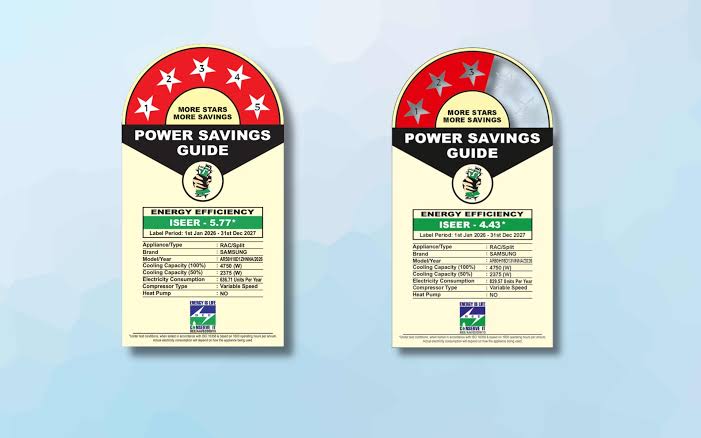
In India, eligible air conditioners carry an energy label under the Bureau of Energy Efficiency’s Standards & Labelling programme.
The star rating indicates the product’s energy-efficiency category under the applicable rating period and product rules.
A higher number of stars represents greater energy efficiency within the relevant rating framework.
This means a 5-star AC is more energy-efficient than a 3-star AC when compared appropriately under the same applicable rating framework.
It does not mean the 5-star AC necessarily provides stronger cooling.
Cooling capacity and energy efficiency are different specifications.
What Is ISEER?
When comparing room air conditioners in India, you may encounter ISEER, or Indian Seasonal Energy Efficiency Ratio.
In simple terms, it represents seasonal cooling output in relation to seasonal energy consumption under specified test conditions.
A higher ISEER indicates better seasonal energy efficiency.
This is useful because air conditioners do not operate at exactly the same cooling load all the time.
Outdoor temperatures and room cooling requirements change throughout the season.
Rather than looking only at the number of stars, compare the actual efficiency information displayed for the models.
1. Energy Efficiency
Winner: 5-star AC
Higher energy efficiency is the primary reason to buy a 5-star AC.
For a comparable cooling requirement, a more efficient AC needs less electrical energy over its operation than a less efficient alternative under corresponding conditions.
This difference becomes increasingly valuable as operating hours increase.
If your AC runs throughout the night for several months, efficiency can have a meaningful effect on total electricity consumption.
If it runs for only a few hours each month, the difference becomes less significant financially.
2. Electricity Bill
Winner: 5-star AC
A 5-star AC should generally have lower electricity consumption than an appropriately comparable 3-star model.
However, your electricity bill cannot be predicted from star rating alone.
Actual consumption depends on:
- AC capacity
- Daily operating hours
- Temperature setting
- Outdoor temperature
- Room insulation
- Sun exposure
- Occupancy
- Door and window opening
- Maintenance
- Installation quality
Electricity tariffs also vary by location and consumption slab.
For this reason, advertisements promising a fixed amount of annual savings should be treated cautiously unless they clearly state the assumptions behind the calculation.
3. Purchase Price
Winner: 3-star AC
A 3-star AC will often have a lower purchase price than a similar 5-star model.
This makes it attractive for households working within a fixed appliance budget.
The price difference can vary significantly depending on:
- Brand
- Capacity
- Compressor technology
- Features
- Wi-Fi connectivity
- Air filtration
- Warranty
- Seasonal discounts
A premium 3-star model may even cost more than a simpler 5-star product from another range.
Compare like-for-like models whenever possible.
4. Cooling Performance
Winner: Tie
A common misconception is that five stars mean more powerful cooling.
They do not.
Star rating primarily concerns energy efficiency.
Cooling ability depends on the AC’s capacity and its ability to handle the room’s heat load.
A correctly sized 3-star AC can cool a suitable room effectively.
A 5-star AC with insufficient capacity may struggle in the same space.
Room size is only one part of sizing. Cooling load can also change according to:
- Ceiling height
- Floor level
- Window area
- Orientation
- Direct sunlight
- Number of occupants
Choose the required capacity first and then compare efficiency.
5. Long Daily Usage
Winner: 5-star AC
This is where paying extra for efficiency becomes easier to justify.
Consider a bedroom where the AC operates for much of the night throughout the warmer months.
Even a relatively small difference in hourly or seasonal electricity consumption can accumulate across hundreds or thousands of operating hours.
A 5-star model is therefore particularly attractive for:
- Frequently used bedrooms
- Living rooms occupied all day
- Home offices
- Homes in climates with long cooling seasons
The greater the usage, the greater the opportunity for efficiency to offset the higher purchase price.
6. Occasional Usage
Winner: 3-star AC, often
Now consider a guest bedroom where the AC operates only a few times each month.
The 5-star model will still be more efficient, but the total electricity saved each year may be relatively small because the AC barely runs.
It could therefore take a long time to recover a substantial difference in purchase price.
A good 3-star AC can make more financial sense in such situations.
This is why star rating should be matched to usage hours, not selected simply on the assumption that more stars are always financially better.
7. Payback Period
Winner: Depends on usage and price difference
A useful way to compare two ACs is to calculate how long the more efficient model takes to recover its additional purchase cost.
For example, suppose:
- 3-star AC costs ₹X
- 5-star AC costs ₹Y
- Extra purchase cost = ₹Y − ₹X
Next, estimate the annual electricity-cost difference using the models’ energy information and your electricity tariff.
Then:
Approximate payback period = Extra purchase cost ÷ Estimated annual electricity savings
This is only an estimate because actual AC usage and electricity tariffs can change.
Still, it provides a much better buying framework than choosing purely by star count.
8. Inverter Technology and Star Rating
Winner: They measure different things
“Inverter” and “5-star” do not mean the same thing.
Inverter refers to the way compressor output can be controlled according to cooling demand.
Star rating represents an energy-efficiency category under the applicable BEE framework.
Therefore, you may encounter different efficiency ratings among inverter AC models.
Do not assume that simply buying an inverter AC guarantees the highest possible efficiency.
Check the actual energy label.
9. Environmental Considerations
Winner: 5-star AC
An efficient AC requires less electricity to deliver the required cooling under corresponding conditions.
For heavily used appliances, reducing electricity consumption can reduce the home’s overall energy demand.
However, efficient operation also depends on how the AC is used.
Simple habits can matter:
- Keep doors and windows closed while cooling.
- Clean filters regularly.
- Avoid unnecessarily low thermostat settings.
- Prevent outdoor-unit airflow obstruction.
- Reduce excessive direct solar heat where practical.
Buying an efficient appliance and then operating it inefficiently reduces the potential benefit.
10. Maintenance Cost
Winner: Tie
A 5-star rating does not automatically mean an AC will be more expensive or cheaper to maintain.
Maintenance cost depends more on the equipment’s design, components, brand, accessibility and condition.
Both 3-star and 5-star ACs need appropriate maintenance.
Typical requirements include:
- Filter cleaning
- Heat-exchanger cleaning when needed
- Drain inspection
- Outdoor-unit inspection
- Professional diagnosis if performance drops
When comparing models, warranty and local service support may be just as important as the star rating.
11. Should You Always Buy a 5-Star AC?
No.
The highest efficiency rating is attractive, but the financial decision depends on how the appliance will be used.
Imagine two rooms.
Room A: Master bedroom, AC used around 8 hours on many summer nights.
Room B: Guest bedroom, AC used perhaps a few hours on occasional weekends.
The 5-star AC is much easier to justify in Room A.
For Room B, a less expensive 3-star model may provide better overall value.
The goal is not simply to buy the highest star rating. It is to choose an AC whose efficiency matches its expected operating hours.
3-Star or 5-Star AC: Which Should You Choose?
Choose a 3-star AC if:
- AC usage will be moderate or occasional.
- Initial purchase budget is important.
- The unit is for a guest or secondary room.
- The price difference for a comparable 5-star model is substantial.
- Your estimated energy savings would take many years to recover the additional cost.
Choose a 5-star AC if:
- The AC will operate for many hours daily.
- It will be used throughout much of the cooling season.
- Reducing electricity consumption is a priority.
- You are buying for a regularly occupied bedroom, living room or home office.
- The additional purchase cost is reasonable relative to expected energy savings.
For a heavily used home AC, 5-star efficiency can be worth paying for.
For occasional cooling, a good 3-star model may be the more economical overall purchase.
How to Compare Two ACs Properly
Start by comparing models with similar cooling capacity.
Then examine:
- Current BEE star rating
- ISEER/efficiency information
- Label period
- Annual energy-consumption information shown on the applicable label
- Purchase price
- Warranty
- Noise
- Installation cost
- Service availability
Pay attention to the label period because energy-rating criteria can be revised over time. An old advertisement or product image may not be directly comparable with a current model under a newer rating framework.
Finally, calculate the likely running-cost difference based on your own expected usage.
That simple calculation can tell you far more than the star sticker alone.
FAQs
Q1. Which is better, a 3-star or 5-star AC?
A. A 5-star AC is generally better for frequent use because of its higher energy efficiency. A 3-star AC can offer better overall value when usage is moderate or occasional and the lower purchase price is important.
Q2. Does a 5-star AC cool better than a 3-star AC?
A. Not necessarily. Star ratings indicate energy efficiency rather than cooling power. Cooling performance depends mainly on capacity, room heat load, product design and installation.
Q3. Does a 5-star AC save a lot of electricity?
A. It can save meaningful electricity when used frequently, but the actual saving depends on the specific models, daily operating hours, room conditions, temperature settings and electricity tariff.
Q4. Is a 3-star AC good for a bedroom?
A. Yes, particularly if the AC is used for limited hours. If the bedroom AC operates throughout most nights for several months, comparing the additional cost and estimated energy savings of a 5-star model is worthwhile.
Q5. How do I know whether paying extra for a 5-star AC is worth it?
A. Compare the purchase-price difference with the estimated annual electricity-cost saving. If frequent usage allows the additional cost to be recovered within a reasonable portion of the AC’s expected service life, the 5-star model can offer better long-term value.