An air conditioner does not face the same cooling load throughout the day. A room may be extremely hot when the AC is first switched on, but after reaching the desired temperature, much less cooling may be required to maintain comfort. How the compressor responds to that changing demand is the main difference between inverter and non-inverter AC technology.
An inverter AC can vary compressor speed according to cooling requirements, whereas a conventional non-inverter AC generally relies more on on-off compressor cycling. For most Indian households that use air conditioning regularly, an inverter AC is generally the better choice because of its part-load efficiency, steadier temperature control and quieter operation.
A non-inverter AC can still make sense where usage is limited and keeping the initial purchase cost low is more important than optimising long-term electricity consumption.

Inverter AC vs Non-Inverter AC: Quick Comparison
| Feature | Inverter AC | Non-Inverter AC |
|---|---|---|
| Compressor operation | Variable | Primarily on/off cycling |
| Energy efficiency | Generally better at part load | Generally lower |
| Temperature stability | Better | More fluctuation |
| Noise | Generally lower | More noticeable cycling |
| Initial cost | Usually higher | Usually lower |
| Long daily usage | Excellent | Less attractive |
| Electronics | More sophisticated | Relatively simpler |
| Repair cost | Can be higher | Can be simpler/cheaper |
| Cooling | Effective when correctly sized | Effective when correctly sized |
| Best for | Regular/long-duration use | Limited or occasional use |
What Is an Inverter AC?
An inverter AC uses electronic control to vary the speed of its compressor according to cooling demand.
When a hot room first needs substantial cooling, the system can operate at a higher output within its designed range.
As the room approaches the selected temperature, the system can reduce compressor output instead of repeatedly operating only at full capacity and then stopping.
This variable operation is important because an AC does not need maximum cooling output continuously.
The term “inverter” refers to this compressor-control technology. It should not be confused with a household power inverter or backup battery system.
What Is a Non-Inverter AC?
A conventional non-inverter AC normally uses a fixed-speed compressor.
When cooling is required, the compressor operates at its designed speed. Once the thermostat determines that the target condition has been reached, the compressor stops.
When the room warms again, it restarts.
This repeated cycle can maintain a comfortable room, but temperature and noise changes may be more noticeable than with a variable-speed system.
Non-inverter ACs have traditionally been attractive because of their simpler technology and lower initial price.
1. Energy Efficiency
Winner: Inverter AC
Energy efficiency is the main reason inverter technology has become popular.
An air conditioner often spends much of its operating time maintaining a room rather than cooling it from extremely hot conditions.
An inverter AC can reduce compressor output as the cooling requirement falls.
This can improve part-load efficiency.
A non-inverter compressor has less ability to adjust its output continuously and relies more heavily on cycling.
However, “inverter” does not automatically mean that every such AC is highly efficient.
Two inverter models can have significantly different efficiency levels.
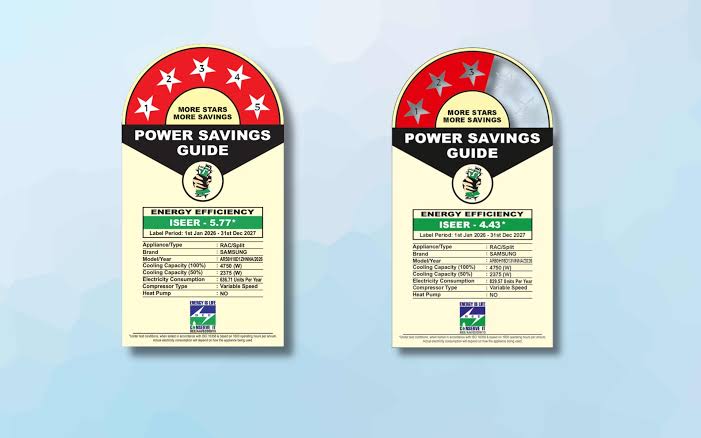
Indian consumers should compare the current BEE energy label and the efficiency information for individual models.
2. Electricity Consumption
Winner: Inverter AC, generally
An inverter AC can consume less electricity over typical operation, particularly when it runs for extended periods and spends substantial time at partial load.
Actual electricity consumption depends on much more than compressor technology.
Important factors include:
- AC capacity
- Energy efficiency
- Room dimensions
- Outdoor temperature
- Sun exposure
- Insulation
- Thermostat setting
- Daily operating hours
- Maintenance
- Installation quality
A highly efficient inverter AC used sensibly may reduce electricity consumption compared with a less efficient fixed-speed model.
But no technology can compensate for severe oversizing, poor installation or continuously leaving doors and windows open.
3. Temperature Control
Winner: Inverter AC
Variable compressor operation allows an inverter AC to adjust its cooling output as room conditions change.
This generally helps maintain a more stable indoor temperature.
A non-inverter system cycles its compressor on and off. As a result, occupants may notice somewhat greater variation around the selected temperature.
For many people, the difference is most noticeable at night when they are sitting or sleeping for long periods without much movement.
Stable operation can make the room feel more consistently comfortable.
4. Cooling Speed
Winner: Inverter AC, depending on model
Some inverter ACs can temporarily operate at elevated compressor output within their designed operating range when rapid cooling is required.
This can help bring down room temperature after startup.
However, cooling speed should not be judged by the word “inverter” alone.
It also depends on:
- Cooling capacity
- Airflow
- Room heat load
- Outdoor conditions
- Product design
An undersized inverter AC can struggle in a room where a correctly sized non-inverter unit performs adequately.
Correct capacity comes first.
5. Noise
Winner: Inverter AC
Inverter systems often operate more quietly once the room approaches the desired temperature because the compressor can continue at reduced output instead of repeatedly stopping and restarting.
The indoor fan and outdoor unit still generate sound.
Actual noise levels vary by model and installation.
Loose panels, vibration, poorly mounted outdoor units and other installation problems can make even a premium AC noisy.
When quiet operation matters, compare the manufacturer’s stated sound levels for the specific models under consideration.
6. Initial Price
Winner: Non-inverter AC
Non-inverter ACs are generally simpler and can have a lower purchase price.
An inverter system needs more sophisticated electronic control, which can increase product cost.
The price difference should be evaluated against expected usage.
If an AC operates many hours every day during a long summer, energy efficiency can become increasingly important over the product’s life.
If it is used only occasionally, the savings may take longer to offset a higher purchase price.
That is why usage pattern matters more than simply asking which technology costs less in the showroom.
7. Maintenance
Winner: Tie for routine maintenance
Routine maintenance requirements are broadly similar.
Both systems benefit from:
- Clean air filters
- Clean heat exchangers
- Unobstructed outdoor airflow
- Correct drainage
- Inspection when performance changes
An inverter AC does contain more sophisticated electronic components, but that does not eliminate normal AC maintenance.
Dirty filters and coils can reduce airflow and efficiency regardless of compressor technology.
Regular cleaning according to the manufacturer’s recommendations helps both types perform properly.
8. Repair Cost
Winner: Non-inverter AC, potentially
The simpler electrical and compressor-control arrangement of a conventional non-inverter system can make certain repairs more straightforward.
Inverter ACs use electronic control boards and variable-speed technology.
If a major electronic component fails outside warranty, replacement can sometimes be expensive.
This does not mean inverter ACs are inherently unreliable.
Product quality, installation, environmental conditions, voltage quality and maintenance all affect reliability.
Before purchasing, compare not only the product warranty but also the terms applicable to important components.
9. Long Daily Usage
Winner: Inverter AC
An inverter AC becomes particularly attractive when air conditioning is used for several hours at a time.
After reaching the desired room condition, it can reduce output to match the lower cooling demand.
This is where variable-speed operation can provide an important efficiency advantage.
Typical examples include:
- Bedrooms used throughout the night
- Living rooms occupied for long periods
- Home offices
- Regular daytime cooling
For such applications, choosing an efficient inverter model usually makes more sense than selecting a basic AC solely because its purchase price is lower.
10. Occasional Usage
Winner: Depends on priorities
Suppose an AC is installed in a guest bedroom and operates only occasionally.
In that situation, the difference in annual electricity consumption between two models may be less financially important than it would be in a bedroom used every night.
A lower-cost non-inverter model could therefore remain reasonable if a suitable one is available.
However, inverter technology has become widespread in the Indian residential AC market, so buyers should compare actual current models rather than assuming a non-inverter option will always provide the best upfront value.
11. Voltage Fluctuations
Winner: Depends on product design
Inverter technology should not be confused with voltage protection.
Manufacturers may specify a voltage operating range for particular models, and some ACs advertise operation across relatively wide supply-voltage conditions.
This varies by product.
Check the manufacturer’s specification for the exact model.
Where the electricity supply experiences severe or repeated voltage problems, follow the AC manufacturer’s recommendations regarding protection rather than assuming that an inverter AC automatically makes additional protection unnecessary.
12. Environmental and Long-Term Considerations
Winner: Inverter AC, generally
Reducing electricity consumption can lower the energy required to operate a home over time.
For a heavily used appliance such as an AC, efficiency therefore matters.
But compressor technology is only part of responsible AC selection.
Also consider:
- Correct capacity
- High energy efficiency
- Appropriate refrigerant system
- Good installation
- Regular maintenance
- Sensible temperature settings
Keeping an inefficient or poorly maintained AC running for long periods can waste energy regardless of whether “inverter” appears on its label.
Inverter or Non-Inverter AC: Which Should You Choose?
Choose an inverter AC if:
- The AC will operate for several hours daily.
- Electricity efficiency is a priority.
- You want steadier room temperature.
- Quiet operation is important.
- The AC is for a regularly occupied bedroom or living room.
- You are willing to pay somewhat more initially for a suitable model.
Consider a non-inverter AC if:
- Usage will be occasional.
- Initial purchase price is the main priority.
- You find a correctly sized, appropriately rated model that suits your requirements.
- Simpler technology is important to you.
For most Indian households buying an AC for regular use, an efficient inverter AC is generally the better long-term option.
But the word “inverter” should never replace proper product comparison.
Check the BEE Label, Not Just the Inverter Sticker
Two inverter ACs can have very different energy performance.
Before purchasing, compare the current BEE energy information provided for the models you are considering.
Also check:
- Cooling capacity
- Rated electricity consumption
- Efficiency information
- Room suitability
- Noise level
- Warranty
- Installation charges
- Service availability
Avoid choosing capacity solely from generic room-size charts. A west-facing top-floor room with large windows can have a very different cooling load from a shaded room of the same floor area.
Correct sizing, efficient equipment and good installation together determine how well an AC performs.
FAQs
Q1. Which is better, inverter AC or non-inverter AC?
A. An inverter AC is generally better for regular household use because variable compressor operation can improve part-load efficiency, maintain steadier temperatures and reduce operating noise. A non-inverter model can remain suitable for limited or occasional use.
Q2. Does an inverter AC save electricity?
A. It can use less electricity than a comparable fixed-speed system, particularly during long operating periods when cooling demand falls below maximum capacity. Actual savings depend on the model, room, temperature setting and usage.
Q3. Does an inverter AC cool faster?
A. Some inverter models can increase compressor output temporarily for faster initial cooling. However, cooling speed also depends on AC capacity, airflow, room heat load and product design.
Q4. Is an inverter AC more expensive to repair?
A. Certain repairs can be more expensive because inverter ACs use sophisticated electronic control components. Repair costs vary considerably by model, component, warranty coverage and manufacturer.
Q5. Is an inverter AC worth buying for a bedroom?
A. It is generally a good choice for a bedroom where the AC operates for several hours or throughout much of the night. Its part-load operation, temperature stability and generally quieter performance are useful for long-duration cooling.