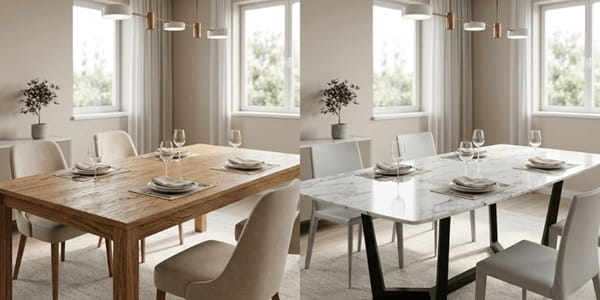
The number of people in your family is not the only number that matters when choosing a dining table. The distance between the table and the nearest wall, sofa or kitchen counter can be equally important. A six-seater may technically fit inside a dining area but still make the room uncomfortable once all six chairs are pulled out.
That is why dining-table capacity should be matched to both household size and usable room dimensions. A four-seater is generally better for couples, small families and compact apartments, while a six-seater provides more flexibility for larger households, guests and multipurpose use.
If space permits without compromising movement, the additional surface area of a six-seater can be valuable. If it makes circulation difficult, a comfortable four-seater is the better choice.
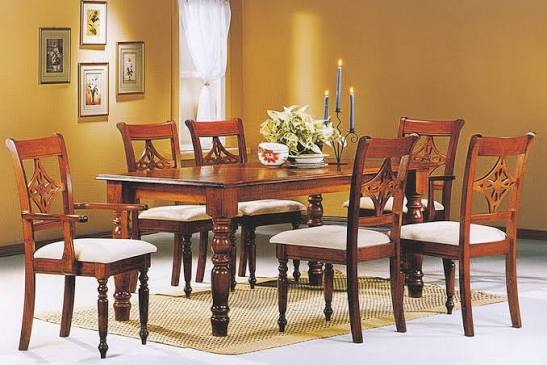
Four-Seater vs Six-Seater Dining Table: Quick Comparison
| Feature | Four-Seater Table | Six-Seater Table |
|---|---|---|
| Normal seating | 4 people | 6 people |
| Floor-space requirement | Lower | Higher |
| Small apartments | Excellent | Depends on layout |
| Guest capacity | Limited | Better |
| Tabletop area | Moderate | Larger |
| Moving/relocation | Easier | More difficult |
| Multipurpose use | Good | Excellent |
| Typical cost | Lower | Higher |
| Best for | Couples/small families | Families/regular guests |
| Room flexibility | Higher | Needs more planning |
What Is a Four-Seater Dining Table?
A four-seater dining table is designed to accommodate four people comfortably under normal conditions.
It is available in several shapes, including:
- Rectangular
- Square
- Round
- Oval
The actual dimensions vary significantly between manufacturers and designs.
A compact four-seater may be intended specifically for an apartment, while a larger round or square model can occupy considerably more floor area.
Four-seaters are popular because they provide enough space for everyday family meals without dominating a small dining room.
What Is a Six-Seater Dining Table?
A six-seater provides seating for approximately six people and therefore needs a larger tabletop and more surrounding space.
Rectangular tables are particularly common because three people can be accommodated along each side or with chairs distributed around the ends.
Round and oval six-seater designs are also available.
The additional tabletop area makes a six-seater useful beyond dining. It can provide more space for serving dishes, laptops, homework and other household activities.
However, these advantages matter only if the room can accommodate the table comfortably.
1. Family Size
Winner: Depends on household
For a household of two to four people, a four-seater usually provides enough everyday capacity.
There is little practical benefit in occupying a large portion of a compact dining room with two permanently unused seats.
A household of five or six people naturally benefits from a six-seater.
But consider visitors as well.
A family of four that frequently hosts grandparents, relatives or friends may find a six-seater much more practical than adding temporary chairs around an undersized table.
Think about typical usage rather than only the number of permanent residents.
2. Small Apartments
Winner: Four-seater
A four-seater is generally the safer choice for compact apartments.
The smaller footprint leaves more room for:
- Walking
- Pulling chairs out
- Opening nearby cabinets
- Moving between the kitchen and living room
- Other furniture
This is particularly important in open-plan apartments where the dining zone shares space with the living room.
A large dining table can visually and physically divide an already limited area.
In such situations, a compact round or rectangular four-seater may provide better overall room functionality.
3. Space for Guests
Winner: Six-seater
A six-seater provides two additional permanent places without needing folding chairs or temporary arrangements.
The larger surface also gives guests more room for plates, glasses and serving dishes.
This can make a substantial difference during:
- Family dinners
- Festivals
- Weekend gatherings
- Birthday meals
- Small celebrations
However, do not automatically buy a six-seater for guests who visit only a few times per year.
An extendable four-seater may be a more efficient solution in a small home.
4. Dining Comfort
Winner: Six-seater for space, provided the room is large enough
A larger table generally provides more tabletop area.
That can make meals more comfortable when several dishes are placed in the centre.
Indian family meals may involve multiple serving bowls, rotis, rice, plates, glasses and condiments simultaneously.
A small tabletop can quickly become crowded.
A six-seater offers more flexibility for serving, but the benefit disappears if chairs are squeezed against walls because the room itself is too small.
Comfort should be evaluated at both the table and room level.
5. Circulation Space
Winner: Four-seater
A dining table needs more floor area than its tabletop dimensions suggest.
Space is required around it so chairs can be pulled out and people can walk behind seated diners.
Before purchasing, mark the proposed tabletop dimensions on the floor using removable tape or another simple method.
Then place chairs approximately where they would sit.
Check whether you can:
- Pull out each chair
- Sit comfortably
- Walk around the table
- Access nearby doors
- Open cabinets
- Reach the kitchen without obstruction
This simple test is much more reliable than deciding from showroom appearance alone.
6. Multipurpose Use
Winner: Six-seater
Dining tables often serve several purposes.
A larger table can become a convenient place for:
- Homework
- Laptop work
- Craft activities
- Board games
- Sorting groceries
- Folding clothes
- Serving buffet-style meals
A six-seater provides greater separation when multiple activities happen simultaneously.
Someone can use a laptop at one end while another person works at the opposite side.
If the dining table doubles as a work or study surface, the extra area may justify the larger size even for a small family.
7. Cleaning and Maintenance
Winner: Four-seater, slightly
There is no major maintenance difference when both tables use the same material.
A four-seater simply has:
- Less tabletop area
- Fewer chairs
- A smaller footprint to clean around
The difference is modest but relevant in a compact home where moving chairs for floor cleaning can become inconvenient.
Table material matters much more.
Wood, marble, glass and engineered surfaces each have different cleaning requirements regardless of seating capacity.
8. Moving and Relocation
Winner: Four-seater
Smaller tables are generally easier to move through:
- Doorways
- Staircases
- Corridors
- Lifts
They are also easier to reposition when rearranging a room.
A six-seater can be heavy and awkward, especially when constructed from solid wood or stone.
If you live in rented accommodation and relocate frequently, check whether the tabletop and base can be dismantled safely for transport.
9. Cost
Winner: Four-seater
When material, construction and brand are comparable, a four-seater generally costs less because it requires a smaller table and two fewer chairs.
However, size is only one part of furniture pricing.
A premium solid-wood four-seater can cost substantially more than a basic engineered-material six-seater.
Price depends on:
- Table material
- Chair construction
- Upholstery
- Brand
- Finish
- Design complexity
- Extendable mechanism
- Tabletop thickness
Compare similar specifications rather than simply comparing seating capacity.
10. Visual Impact
Winner: Depends on room size
A dining table should look proportional to the room.
A small table placed in a very large dining area can look undersized and leave excessive empty space.
A six-seater can anchor a large dining zone and create a stronger visual centre.
The opposite applies in a compact apartment.
An oversized six-seater may make the entire living-dining area feel crowded.
Choosing furniture in proportion to the room usually produces a better result than buying the largest table that physically fits.
What About Table Shape?
Seating capacity alone does not determine how much room a table occupies.
Rectangular Tables
Rectangular tables work particularly well in long dining areas and are common for both four- and six-seat arrangements.
Round Tables
Round tables encourage conversation and eliminate sharp corners. They can work well in square dining areas, although larger round tables require considerable overall width.
Square Tables
A square four-seater can suit a compact square dining zone. Large square tables can make reaching items in the centre more difficult.
Oval Tables
Oval designs provide some of the surface area of rectangular tables while softening the corners, which can improve movement in certain layouts.
Measure the exact product rather than assuming one shape is always more space-efficient.
Which Dining Table Should You Choose?
Choose a four-seater dining table if:
- Your household has two to four people.
- You live in a compact apartment.
- Guests are relatively infrequent.
- Easy movement around the room matters.
- You may relocate frequently.
- The dining area shares space with the living room.
Choose a six-seater dining table if:
- Your household has five or six people.
- Relatives or friends visit frequently.
- The dining area is sufficiently spacious.
- You regularly place several serving dishes on the table.
- The table doubles as a work or study surface.
- You want additional seating flexibility.
For a small household with occasional guests, there is also a useful third option: an extendable dining table.
It can remain compact for everyday meals and provide additional seating when required.
Measure Before You Buy
Do not measure only the empty wall or dining zone.
Record the table’s actual dimensions and then account for the chairs when they are occupied.
Also check nearby:
- Kitchen counters
- Refrigerator doors
- Balcony doors
- Storage cabinets
- Sofas
- Passageways
If choosing between two sizes, prioritise comfortable circulation over extra seating that will rarely be used.
A dining table should make the room easier to use, not force people to turn sideways every time they walk past it.
FAQs
Q1. Which is better, a four-seater or six-seater dining table?
A. A four-seater is generally better for small families and compact homes. A six-seater is better for larger families, frequent guests and households that need more tabletop space.
Q2. Is a four-seater dining table enough for a family of four?
A. Yes. A properly sized four-seater should comfortably accommodate a family of four for everyday meals. A larger table may still be useful if guests visit frequently or several serving dishes are normally placed on the table.
Q3. Can a six-seater dining table fit in a small apartment?
A. It can if the dining area has sufficient clearance, but the complete layout should be measured first. Remember that additional space is needed around the tabletop for chairs and circulation.
Q4. Should a family of four buy a six-seater table?
A. It can make sense if the home has enough space and the family frequently entertains guests or uses the dining table for work and study. Otherwise, a four-seater uses floor space more efficiently.
Q5. Is an extendable dining table better for a small family?
A. An extendable table can be an excellent compromise. It provides a compact surface for everyday use while allowing additional seating when guests arrive, provided there is enough room to use it comfortably when extended.