A dining table has to handle much more than meals. It may become a homework desk in the afternoon, a work table during the day and a serving counter when guests arrive. That makes the tabletop material a practical decision, not simply an interior-design choice.
Wood and marble create very different dining experiences. Wood feels warmer, is available in many styles and can often be repaired or refinished when it becomes worn. Marble provides a distinctive natural-stone appearance and substantial, premium feel, but its weight and sensitivity to certain spills require more attention.
For most households, a good-quality wooden dining table offers greater everyday practicality and repairability, while marble is better when natural-stone appearance, weight and a luxurious finish are the main priorities.
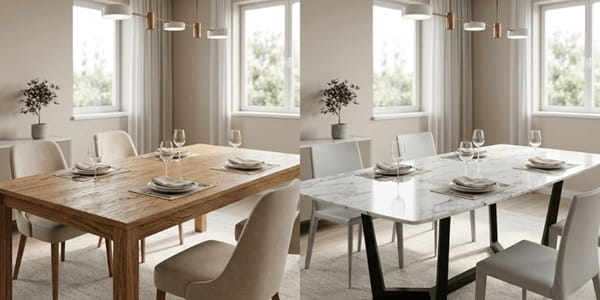
Wooden vs Marble Dining Table: Quick Comparison
| Feature | Wooden Dining Table | Marble Dining Table |
|---|---|---|
| Appearance | Warm and natural | Premium and elegant |
| Weight | Moderate to heavy | Very heavy |
| Stain resistance | Finish-dependent | Needs care, especially with acidic spills |
| Scratch resistance | Can scratch | Hard surface but can still scratch/etch |
| Heat | Use mats/trivets | Heat-resistant stone, but trivets remain advisable |
| Repairability | Generally good | More specialised |
| Moving | Easier | Difficult |
| Design options | Extensive | Extensive natural patterns |
| Maintenance | Moderate | Moderate to high |
| Best for | Everyday family use | Statement/premium dining areas |
What Is a Wooden Dining Table?
A wooden dining table can be made from solid wood, engineered wood, veneer-covered panels or a combination of materials.
Common solid woods used for furniture in India include:
- Teak
- Sheesham
- Mango wood
- Acacia
- Oak and other imported species
However, the phrase “wooden dining table” does not automatically mean solid wood.
A table may have a plywood, MDF or other engineered substrate covered with veneer or another decorative finish.
This distinction affects price, durability, weight and repairability. Always check the actual construction rather than relying only on the word “wooden.”
What Is a Marble Dining Table?
A marble dining table uses natural marble for the tabletop or as a major surface layer.
Because marble is a natural stone, every slab can have different:
- Veining
- Colour variations
- Patterns
- Mineral characteristics
This uniqueness is part of its appeal.
Some tables marketed as marble may instead use engineered stone, sintered material, ceramic or a marble-look surface. These materials can perform differently from natural marble.
If natural stone is important to you, confirm exactly what the tabletop is made from before purchasing.
1. Appearance
Winner: Personal preference
Wood creates warmth.
Its grain, colour and texture work particularly well with interiors designed around natural materials.
Depending on the finish, a wooden table can suit:
- Traditional homes
- Scandinavian interiors
- Contemporary apartments
- Rustic interiors
- Minimalist dining areas
Marble creates a more formal visual statement.
The natural veining can turn a large tabletop into the focal point of the dining room.
White or light marble can make a space feel brighter, while darker stones create a dramatic appearance.
Neither is objectively more attractive. They simply create different moods.
2. Everyday Durability
Winner: Wood for forgiving daily use
A quality wooden table can last for many years when constructed and maintained properly.
It can develop scratches and dents, but these signs of use do not necessarily make the table unusable. Depending on the construction and finish, some solid-wood tables can eventually be sanded and refinished.
Marble is hard, but hardness should not be confused with being indestructible.
A strong impact can potentially chip an edge, and natural marble can react differently to spills and cleaning products than a typical furniture finish.
For a busy family dining table that receives constant daily use, wood is often the more forgiving material.
3. Stain Resistance
Winner: Depends on finish and maintenance
Neither material should be assumed to be stain-proof.
A wooden tabletop is normally protected by a coating such as lacquer, polyurethane, oil or another furniture finish. Its resistance to spills therefore depends significantly on that protective layer.
Natural marble is a porous stone and may absorb liquids if they remain on an inadequately protected surface.
Food and beverages should be wiped promptly.
Particular care is needed with acidic substances such as:
- Lemon juice
- Vinegar
- Some fruit juices
- Certain sauces
Acids can affect calcium-based stones such as marble and may leave dull areas known as etching.
Coasters, placemats and prompt cleaning are useful with both materials.
4. Scratch Resistance
Winner: Marble for hardness, but with an important limitation
Marble is harder than many common wooden furniture surfaces and can resist some forms of everyday scratching better.
However, it can still be scratched by sufficiently hard materials.
It can also develop etching, which is different from a scratch but can appear as a dull patch on a polished surface.
Wood scratches more easily, particularly when hard objects are dragged across the tabletop.
The advantage of wood is that certain scratches can be repaired or made less noticeable through refinishing.
Use table mats rather than sliding heavy serving dishes across either surface.
5. Heat Resistance
Winner: Marble, with sensible precautions
Natural stone handles heat better than a typical finished wooden surface.
A hot vessel placed directly on wood can damage or discolour its protective coating.
Marble is more heat-resistant, but putting extremely hot cookware directly onto a dining table is still unnecessary.
Sudden temperature differences, surface treatments and the construction beneath the stone can all matter.
Using a trivet takes only seconds and protects an expensive table regardless of material.
6. Weight and Portability
Winner: Wood
This difference becomes obvious when the furniture needs to be moved.
A large marble slab is extremely heavy.
The base must be designed to support it properly, and relocating the table may require several people or professional movers.
The weight can also make installation more difficult in:
- Upper-floor apartments
- Homes with narrow staircases
- Buildings with small lifts
- Rooms with restricted entrances
Wooden tables vary in weight, but most are easier to relocate than an equivalent marble-top table.
If you move homes frequently, this can be a significant advantage.
7. Maintenance
Winner: Wood, generally
A well-finished wooden dining table normally needs routine dusting and careful cleaning of spills.
Its exact maintenance depends on the finish.
Natural marble needs appropriate stone-care practices. Harsh acidic or abrasive cleaners should be avoided.
Depending on the stone and finish, periodic sealing may also be recommended. Follow the stone supplier’s guidance rather than applying random household chemicals.
The most important rule is simple: clean spills promptly.
This is particularly important with coloured or acidic foods.
8. Repairability
Winner: Wood
Repairability is one of wood’s strongest advantages.
Depending on the type of wood and construction, a damaged tabletop may be:
- Sanded
- Polished
- Refinished
- Repaired locally
- Recoated
Solid wood generally offers the greatest refinishing potential.
Damage to marble can require a stone specialist. Minor issues may be polished or treated, but chips, cracks and severe etching can be more complicated to restore.
A broken stone tabletop is also considerably more difficult to handle physically because of its weight.
9. Cost
Winner: Depends on specification
There is no reliable rule that wood is always cheaper than marble.
Both categories cover enormous price ranges.
A basic engineered-wood dining table can be relatively economical, while a handcrafted solid teak table can be expensive.
Similarly, marble prices vary according to:
- Stone variety
- Slab size
- Thickness
- Origin
- Veining
- Finish
- Fabrication
- Edge profile
The base also affects cost.
When comparing prices, determine whether you are comparing solid wood with natural marble or lower-cost engineered alternatives marketed using similar visual descriptions.
10. Which Is Better for Homes With Children?
Winner: Wood, generally
For active family use, wood is often the more forgiving option.
Scratches or small dents may be easier to accept and, depending on the table, repair later.
A heavy marble table requires additional attention to its edges, stability and supporting base.
Furniture safety also depends on the complete design rather than just the tabletop material. A dining table should have a stable base and should not rock or tip during normal use.
Rounded corners can be worth considering in areas where people frequently walk close to the table.
11. Long-Term Appearance
Winner: Tie
Both materials can age beautifully, but in different ways.
Natural wood can develop character as its colour and surface change with use. A quality solid-wood table may also be refinished if the owner wants to refresh its appearance.
Marble has naturally unique patterns that do not go out of fashion in the same way as some artificial decorative finishes.
However, maintaining a highly polished marble surface requires proper care.
The better long-term choice therefore depends on whether you prefer the evolving warmth of wood or the distinctive stone character of marble.
Which Dining Table Should You Choose?
Choose a wooden dining table if:
- The table will receive heavy everyday use.
- You want a warm, natural appearance.
- Moving the furniture may be necessary.
- Repairability matters.
- You prefer a wide variety of furniture styles.
- You want a practical family dining table.
Choose a marble dining table if:
- You want a premium statement piece.
- Natural veining is part of the interior design.
- The table will remain in a fixed location.
- Its considerable weight is not a problem.
- You are willing to follow suitable stone-care practices.
- The dining area has enough visual space for a substantial table.
For many everyday family dining rooms, wood provides an excellent balance of appearance, usability and long-term repairability.
Marble becomes particularly attractive when the dining table is intended to be a major visual feature and the household is comfortable with the additional weight and maintenance considerations.
Check the Construction, Not Just the Top
A dining table is only as reliable as its complete structure.
For a wooden table, check:
- Solid wood or engineered construction
- Wood species
- Joinery
- Surface finish
- Tabletop thickness
- Base stability
For a marble table, check:
- Natural or engineered material
- Slab thickness
- Stone support
- Base construction
- Edge finishing
- Surface treatment
A heavy stone top needs a base engineered to support its weight safely.
Similarly, an expensive wooden top will not compensate for weak joints or an unstable frame.
Before buying, sit at the table, check legroom, gently test its stability and confirm that the size leaves enough circulation space around the dining area.
FAQs
Q1. Which is better, a wooden or marble dining table?
A. A wooden dining table is generally better for practical everyday use, easier movement and repairability. A marble dining table is better for homeowners who prioritise a substantial premium appearance and natural-stone design.
Q2. Does a marble dining table stain easily?
A. Natural marble can absorb some spills and can also be etched by acidic substances. Prompt cleaning, appropriate stone care and any sealing recommended for the particular stone help maintain the surface.
Q3. Do wooden dining tables scratch easily?
A. Wood can develop scratches, particularly when hard objects are dragged across the surface. The advantage is that many solid-wood tables can be repaired or refinished depending on the depth of the damage and type of finish.
Q4. Can hot utensils be placed directly on a marble dining table?
A. Marble tolerates heat better than many finished wooden surfaces, but using trivets or heat-resistant mats is still advisable. It protects the stone, its finish and the underlying table construction.
Q5. Which dining table is easier to move?
A. A wooden dining table is generally easier to relocate. Marble tops can be extremely heavy and may require several people or professional handling, particularly for large dining tables.