The best time to decide how electrical wires will travel through a home is before the walls receive their final finish. Once plaster, paint, tiles and furniture are complete, changing the wiring route can mean cutting walls, adding visible trunking or accepting compromises in where new electrical points can be installed.
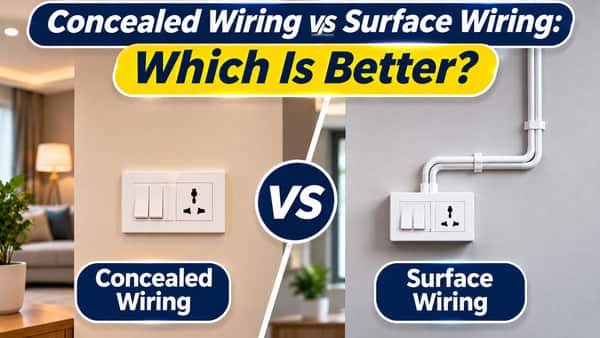
The two broad approaches are concealed and surface wiring. Concealed wiring is generally better for new homes and finished residential interiors because cables and conduits remain hidden. Surface wiring is better when easy access, quick installation and future modification matter more than appearance.
Both can form safe electrical installations when properly designed with suitable materials and installed by qualified professionals.
Concealed Wiring vs Surface Wiring: Quick Comparison
| Feature | Concealed Wiring | Surface Wiring |
|---|---|---|
| Visibility | Hidden inside walls/ceilings | Visible on wall/ceiling surface |
| Appearance | Clean and minimal | More functional |
| Installation | More involved | Faster |
| Initial cost | Usually higher | Usually lower |
| Fault access | More difficult | Easier |
| Future modifications | More difficult | Easier |
| Best stage to install | Construction/major renovation | Any stage |
| Wall cutting | Usually required | Minimal |
| Residential interiors | Excellent | Application-dependent |
| Best for | Permanent finished homes | Renovations, utility areas, additions |
What Is Concealed Wiring?
In a concealed electrical installation, conduits are embedded within walls, slabs or ceilings, and electrical conductors run through those conduits.
After plastering and painting, most of the system is invisible.
Only components such as switches, sockets, distribution boards and electrical fixtures remain visible.
This approach is common in modern residential construction because it allows electrical services to be integrated into the building without exposed wiring routes affecting the interior design.
Planning is particularly important because changes become more difficult once the walls are finished.
What Is Surface Wiring?
Surface wiring places the wiring system on the finished surface of walls or ceilings rather than burying it inside them.
Depending on the installation, conductors may be protected using suitable:
- Conduits
- Trunking
- Raceways
- Channels
The exact method and materials must be appropriate for the electrical installation and environment.
Surface wiring is often useful in existing buildings where cutting walls would be expensive, disruptive or undesirable.
It is also commonly considered for utility spaces and locations where easy access to electrical services is more important than hiding them.
1. Appearance
Winner: Concealed wiring
Appearance is the most obvious advantage of concealed wiring.
Conduits and conductors disappear behind the finished wall, leaving only switches, sockets and fixtures visible.
This works particularly well with modern interiors where clean walls are part of the design.
Surface systems remain visible.
Careful routing and good-quality trunking can make them neat, but they still become part of the visual environment.
For living rooms, bedrooms and premium interiors, concealed wiring generally provides the more polished result.
2. Installation During New Construction
Winner: Concealed wiring
A new house provides the ideal opportunity to install concealed electrical infrastructure.
Routes can be planned before plastering, allowing conduits and electrical boxes to be positioned according to the room design.
At this stage, homeowners can plan for:
- Lighting
- General sockets
- Air conditioners
- Television
- Internet/networking
- Kitchen appliances
- Water heaters
- Washing machine
- Workstations
Planning these points early reduces the need for visible additions later.
If concealed wiring is already part of the construction sequence, its installation is considerably less disruptive than trying to add it after the house is complete.
3. Installation in an Existing Home
Winner: Surface wiring
The situation reverses during renovation.
Adding a concealed electrical route to a finished room may require cutting or chasing the wall, installing conduit, repairing plaster and repainting.
Tiles or decorative finishes can make the process even more complicated.
Surface wiring can often be installed with much less civil work.
This makes it useful when adding:
- An extra socket
- New lighting
- A dedicated appliance point
- Electrical supply to a renovated area
- Temporary or future-adjustable services
A properly planned surface route can save considerable disruption.
4. Access for Repairs
Winner: Surface wiring
Surface wiring provides a clear advantage when physical access to the wiring route is required.
Conduits or trunking are accessible without opening the wall.
With concealed systems, troubleshooting may be more complicated if there is damage to the conduit, a blocked route or another physical problem inside the wall.
However, properly planned concealed wiring should provide accessible electrical boxes and suitable routes so that conductors can be maintained without unnecessarily breaking walls.
Good installation at the construction stage is therefore critical.
5. Future Modifications
Winner: Surface wiring
Homes change over time.
A bedroom may become a home office. A new air conditioner may be installed. The television may move to another wall.
Surface systems make many such changes easier because the electrical route can be extended or modified without major wall work.
Concealed wiring is less flexible after completion.
The best way to reduce this disadvantage is to plan spare capacity during construction, including appropriate conduit routes and electrical points where future equipment is reasonably expected.
That requires coordination between the homeowner, electrical professional and interior designer.
6. Protection From Physical Contact
Winner: Concealed wiring, when correctly installed
A concealed system keeps conduits away from normal room activity.
Furniture, cleaning equipment and everyday movement are less likely to strike the wiring route because it sits within the building structure.
Surface wiring is more exposed to its surroundings.
This makes the choice of conduit or trunking, fixing method and route particularly important.
Surface systems should not be placed where they are likely to receive repeated impact or other mechanical damage unless suitable protection is provided.
7. Installation Time
Winner: Surface wiring
Surface wiring is generally faster to install because it requires less wall chasing and subsequent finishing.
The electrician can install the appropriate surface containment system and route the conductors through it.
Concealed wiring needs greater coordination with construction work.
The process can involve:
- Marking routes
- Preparing chases where applicable
- Installing conduits and boxes
- Checking the routes
- Completing wall finishes
- Pulling/connecting conductors as designed
- Installing accessories
- Testing
The exact construction sequence varies, but concealed installations generally demand more planning.
8. Cost
Winner: Surface wiring, generally
Surface wiring is often less expensive when it avoids extensive civil work.
Concealed wiring may involve additional costs for:
- Wall preparation
- Conduits
- Electrical boxes
- Labour
- Plaster repair
- Finishing
- Coordination with construction
During new construction, the difference may be easier to absorb because wall work is already underway.
During renovation, however, creating new concealed routes can become considerably more expensive than installing neat surface trunking.
The lowest initial quotation should not be the only consideration. Electrical safety and component quality should never be reduced simply to lower the project cost.
9. Cleaning and Everyday Maintenance
Winner: Concealed wiring
Concealed wiring leaves fewer external components on the wall.
This means there are no exposed conduit or trunking surfaces collecting dust along the wiring route.
Surface installations add edges and horizontal surfaces where dust can accumulate.
They therefore need occasional external cleaning.
This is mainly a convenience and appearance issue rather than a major technical disadvantage.
10. Safety
Winner: Tie when properly designed and installed
It is incorrect to assume that wiring is safe simply because it is hidden.
Likewise, visible surface wiring is not automatically unsafe.
Electrical safety depends on the complete installation, including:
- Correct conductor sizing
- Suitable insulation
- Appropriate conduit or containment
- Proper terminations
- Earthing
- Protective devices
- Circuit design
- Workmanship
Relevant Indian electrical requirements and applicable product standards should be followed.
Poorly installed concealed wiring can create serious problems that are difficult to access. Poorly protected surface wiring can be vulnerable to physical damage.
The installation method cannot compensate for bad electrical work.
11. Residential vs Utility Areas
Winner: Depends on location
There is no requirement for the entire property to use the same visual approach.
Concealed wiring makes particular sense in:
- Living rooms
- Bedrooms
- Dining rooms
- Finished kitchens
- Premium interior spaces
Surface systems can be practical in suitable:
- Garages
- Workshops
- Utility rooms
- Storage areas
- Existing buildings undergoing limited renovation
The decision can therefore be made room by room.
A home may use concealed wiring throughout the main interiors while using appropriately designed surface systems for later additions or utility spaces.
Concealed or Surface Wiring: Which Should You Choose?
Choose concealed wiring if:
- You are constructing a new home.
- A clean interior appearance is important.
- Electrical points can be planned in advance.
- You expect the room layout to remain relatively stable.
- You want electrical routes protected within the building finish.
Choose surface wiring if:
- You are modifying an existing property.
- Breaking finished walls is undesirable.
- Future alterations are likely.
- Easy access to wiring routes is important.
- The installation is in a suitable utility or functional area.
For most newly constructed homes, concealed wiring is generally the preferred solution for main living spaces.
For renovations and later additions, surface wiring can be a highly practical alternative when it is professionally designed and installed using appropriate containment.
Plan Electrical Points Before Plastering
The biggest advantage of concealed wiring is also its biggest planning challenge: once everything is hidden, moving a point is much harder.
Before walls are finished, review the electrical layout room by room.
Think about where you expect to place:
- Beds
- Televisions
- Study desks
- Refrigerators
- Microwave ovens
- Washing machines
- Water heaters
- Air conditioners
- Wi-Fi/network equipment
Also consider future needs rather than only the appliances you currently own.
The exact circuit design, cable sizing and protective devices should be determined by a qualified electrical professional. Do not attempt mains electrical installation or modification based solely on general online guidance.
FAQs
Q1. Which is better, concealed wiring or surface wiring?
A. Concealed wiring is generally better for new residential interiors because it provides a clean appearance and keeps wiring routes hidden. Surface wiring is better for renovations, later additions and situations where easy access or modification is important.
Q2. Is concealed wiring more expensive?
A. It is generally more expensive to install, particularly in an already finished home, because wall preparation and subsequent finishing may be required. During new construction, it is easier to integrate into the overall building work.
Q3. Is surface wiring safe for homes?
A. It can be safe when properly designed, protected with suitable containment, correctly installed and supported by appropriate earthing and protective devices. Electrical work should be performed by qualified professionals.
Q4. Which wiring system is easier to repair?
A. Surface wiring generally provides easier physical access because the conduit or trunking is visible. Concealed systems can be more difficult to access if a problem occurs inside a wall.
Q5. Can a home use both concealed and surface wiring?
A. Yes. Concealed wiring can be used for the main electrical installation, while appropriately designed surface wiring can be used for later additions, renovations or utility areas where opening finished walls would be impractical.