Wall panels are often selected from a catalogue of colours, grooves and wood-look finishes, but two panels that look almost identical in photographs can behave very differently once installed. Their core material determines how rigid they feel, how much weight they add to the wall, where they can be installed and what happens when they are exposed to moisture or everyday impact.
WPC and PVC panels are both popular alternatives to conventional painted or laminate-finished walls, but they serve somewhat different purposes. WPC panels are generally better when strength, rigidity and a more substantial decorative finish are priorities, while PVC panels are better when low weight, economical installation and easy cleaning matter most.
The exact performance varies considerably by product, so the manufacturer’s specifications should always be checked before deciding where a panel can be installed.
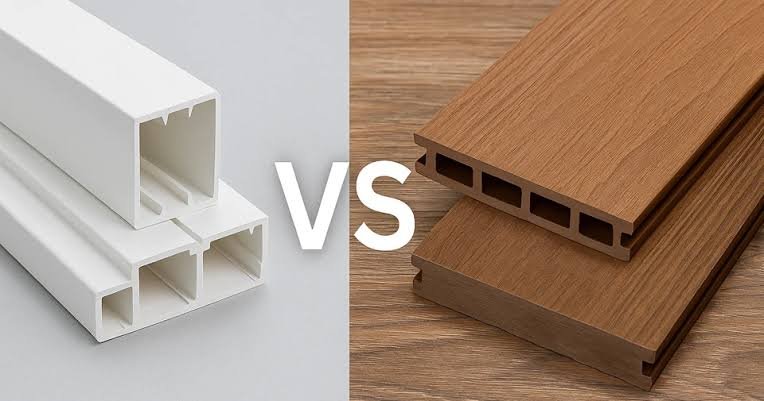
WPC vs PVC Wall Panels: Quick Comparison
| Feature | WPC Wall Panels | PVC Wall Panels |
|---|---|---|
| Basic composition | Wood fibre/flour + polymer composite | Primarily PVC-based |
| Weight | Generally heavier | Lightweight |
| Rigidity | Generally higher | Product-dependent, often lighter/flexible |
| Moisture resistance | Good with suitable product | Excellent inherent water resistance |
| Impact resistance | Generally better | Depends heavily on construction |
| Cleaning | Easy | Very easy |
| Installation | Moderate | Generally easy |
| Wood-like appearance | Often convincing | Available in printed/textured finishes |
| Cost | Usually higher | Usually lower |
| Best for | Feature walls, substantial decorative applications | Economical decorative wall covering |
What Are WPC Wall Panels?
WPC stands for Wood Plastic Composite.
The material generally combines wood-derived fibres or flour with thermoplastic polymers and additives. Exact formulations vary among manufacturers.
This combination allows manufacturers to produce profiles with a wood-inspired appearance while reducing some of the moisture-related concerns associated with untreated natural wood.
Interior WPC products are available in forms such as:
- Fluted panels
- Slatted wall panels
- Decorative boards
- Louvers
- Wood-look profiles
They are frequently used behind televisions, on bedroom feature walls, in reception areas and in other decorative applications.
Not every product sold as WPC has the same composition or performance, making manufacturer specifications particularly important.
What Are PVC Wall Panels?
PVC stands for Polyvinyl Chloride.
PVC wall panels are manufactured primarily from plastic-based material and are available in numerous decorative finishes.
Depending on the product, the surface can imitate:
- Marble
- Wood
- Stone
- Tiles
- Solid colours
- Decorative patterns
PVC panels are generally lightweight and resistant to water absorption by the PVC material itself.
They are often selected when homeowners want to cover an existing wall relatively quickly without creating a heavy decorative assembly.
1. Strength and Rigidity
Winner: WPC, generally
WPC decorative profiles are generally more substantial and rigid than lightweight PVC wall panels.
This can give a WPC installation a more solid feel.
The difference is particularly noticeable with thicker fluted or louvered profiles used to create architectural feature walls.
PVC panels vary greatly.
Some products are relatively rigid, while thin hollow or lightweight sheets may be easier to dent or damage through impact.
Thickness and internal construction therefore matter.
Never compare WPC and PVC based only on a small showroom sample or surface print.
2. Weight
Winner: PVC
PVC’s low weight is one of its practical advantages.
Lightweight panels are easier to:
- Carry
- Cut
- Position
- Install
- Handle during renovation
This can simplify work on large wall areas.
WPC profiles are typically heavier because of their composite construction.
The additional weight is not necessarily a disadvantage, but the wall, supporting framework and fixing method should be suitable for the product.
For either material, follow the manufacturer’s recommended installation system rather than relying only on adhesive where mechanical fixing is specified.
3. Moisture Resistance
Winner: PVC for inherent water resistance
PVC itself does not absorb water in the way natural wood can.
This makes PVC panels attractive for areas where surfaces may encounter humidity or occasional splashes, provided the complete panel system is approved for that application.
WPC also provides good resistance to moisture compared with untreated natural wood because it contains polymer along with wood-derived material.
However, WPC formulations vary.
A product designed for an indoor living-room wall should not automatically be assumed suitable for an exterior façade, shower enclosure or continuously wet location.
Always check the manufacturer’s intended-use specification.
4. Appearance
Winner: WPC for wood-style feature walls
WPC is particularly popular for creating vertical fluted or slatted surfaces.
The combination of three-dimensional profiles and wood-inspired finishes can create a more architectural appearance than a simple flat wall covering.
It works especially well for:
- TV walls
- Bed-back walls
- Entrance areas
- Dining walls
- Office feature walls
PVC offers much greater freedom when the goal is to imitate different decorative surfaces at an economical price.
Printed PVC products can reproduce marble, stone, wood and many other patterns.
The better material therefore depends on the intended design.
5. Installation
Winner: PVC for simplicity
Lightweight PVC panels can be relatively quick to install when the wall and selected product are suitable.
Some systems use interlocking edges, adhesives, mechanical fixing or a combination of methods.
WPC profiles may require more careful alignment and fixing because they are heavier and are often used to create precise vertical patterns.
Installation quality matters greatly with fluted panels.
Even a small alignment error can become obvious when repeated grooves run from floor to ceiling.
The wall should also be inspected for significant unevenness before either type of panel is installed.
6. Cleaning
Winner: PVC, slightly
PVC surfaces are generally easy to wipe clean.
This makes them convenient in interiors where low-maintenance wall finishes are desirable.
WPC surfaces are also relatively easy to maintain, but heavily grooved or fluted designs can collect dust between their profiles.
The practical cleaning requirement therefore depends as much on the shape of the panel as the material.
A flat WPC surface can be easier to clean than a deeply fluted PVC panel, for example.
Avoid harsh cleaning chemicals unless the manufacturer confirms compatibility with the decorative finish.
7. Termites and Biological Attack
Winner: PVC
PVC contains no wood fibre and is not a food source for termites.
WPC contains wood-derived material encapsulated within a polymer composite. It is generally promoted as more resistant to termites than natural timber, although performance depends on formulation and manufacturing quality.
Neither panel should be used to hide an active termite problem in the building.
If termites are already present in wooden furniture, door frames or other structural components, the infestation should be properly investigated and treated.
Decorative wall panels are not pest-control systems.
8. Fire Performance
Winner: Product-specific
It would be misleading to declare either WPC or PVC automatically “fireproof.”
Both contain polymer-based materials, and their reaction to fire depends on the formulation, additives, thickness and product construction.
If fire performance is important for the project, request relevant test data or certification for the specific panel being purchased.
Do not rely solely on marketing descriptions such as:
- Fire-resistant
- Flame-retardant
- Fireproof
These terms can refer to very different performance levels.
This is especially important for commercial interiors and locations with specific fire-safety requirements.
9. Heat and Direct Sunlight
Winner: Product-dependent
Plastic and composite materials can change dimensions with temperature.
Excessive heat and direct sunlight can also affect certain decorative surface finishes over time.
For walls receiving strong afternoon sunlight, verify whether the particular panel is suitable for that exposure.
Installation instructions may specify expansion gaps or other allowances.
This is another reason an indoor decorative panel should not automatically be used outdoors.
Exterior applications need products specifically designed for weather exposure.
10. Repair and Replacement
Winner: Depends on installation method
If an individual panel becomes damaged, replacement can be straightforward when the installation system allows individual pieces to be removed.
However, panels bonded heavily to the wall can be more difficult to replace without damaging adjacent sections or the underlying plaster.
WPC fluted panels may also need careful colour and pattern matching when replacing one section later.
Decorative batches can vary.
If the installation is large, keeping a small quantity of spare material from the original batch can be useful for future repairs.
11. Cost
Winner: PVC
PVC panels are generally the more economical option, particularly for covering larger areas.
WPC decorative profiles often cost more because they are heavier, thicker and designed to create a more substantial architectural finish.
The complete project cost should include:
- Panels
- Adhesive
- Framework, if required
- Fasteners
- Edge trims
- Labour
- Surface preparation
- Electrical cut-outs
- Finishing
Do not compare only the per-panel price because WPC and PVC products can have different dimensions and installation requirements.
12. Durability
Winner: WPC for demanding decorative applications
A good-quality WPC profile can provide a robust decorative surface in living areas and other suitable indoor spaces.
Its greater rigidity can make it more resistant to minor everyday impacts than very lightweight PVC panels.
But quality varies significantly in both categories.
Thin, poorly manufactured WPC should not automatically be considered better than a well-engineered PVC panel.
Before purchasing, physically inspect the product for:
- Thickness
- Rigidity
- Surface quality
- Edge consistency
- Joint quality
- Finish adhesion
A wall panel is a complete manufactured product, so the manufacturer’s quality can matter as much as the basic material name.
WPC or PVC Wall Panels: Which Should You Choose?
Choose WPC wall panels if:
- You want a substantial feature wall.
- A wood-inspired appearance is the priority.
- Fluted or louvered designs are planned.
- Greater rigidity is desirable.
- You are comfortable with a higher material cost.
- The panel will be used in an application approved by its manufacturer.
Choose PVC wall panels if:
- Budget is important.
- Lightweight construction is preferred.
- Easy cleaning matters.
- You need to cover a relatively large wall area.
- Marble, stone or other printed effects are desired.
- Fast installation is a priority.
For premium living-room or bedroom feature walls, WPC is often the more attractive choice.
For economical decorative covering and moisture-tolerant applications where the specific product is approved, PVC can offer better value.
Check the Wall Before Covering It
Wall panels can hide stains, cracks and uneven surfaces, but hiding a problem does not repair it.
Before installing either WPC or PVC, inspect the wall for:
- Active dampness
- Water leakage
- Mould
- Termite activity
- Loose plaster
- Major cracks
The underlying cause should be corrected before the wall is covered.
Also plan electrical points in advance. Switches, sockets and television connections should be properly extended and finished rather than buried behind decorative panels.
Finally, ask the supplier exactly where the selected product can be used. Indoor, wet-area and exterior panels can have very different specifications even when they look similar in a catalogue.
FAQs
Q1. Which is better, WPC or PVC wall panels?
A. WPC is generally better for substantial decorative feature walls and wood-style fluted designs, while PVC is better when lightweight construction, easy maintenance and lower cost are the main priorities.
Q2. Are WPC wall panels waterproof?
A. WPC has good moisture resistance compared with untreated natural wood, but performance varies by product. A particular WPC panel should only be used in wet or exterior conditions if the manufacturer specifies it for that application.
Q3. Are PVC wall panels good for bedrooms?
A. PVC panels can be used as decorative bedroom wall finishes when the product is intended for indoor residential use. Consider the desired appearance, product quality and relevant material-performance information before selection.
Q4. Which is more expensive, WPC or PVC?
A. WPC decorative panels are generally more expensive than lightweight PVC panels. Actual cost depends on thickness, design, finish, brand, installation system and labour.
Q5. Can WPC or PVC panels be installed over a damp wall?
A. They should not be used simply to hide active dampness or leakage. The source of moisture should first be identified and repaired; otherwise, concealed deterioration or mould-related problems can continue behind the panels.