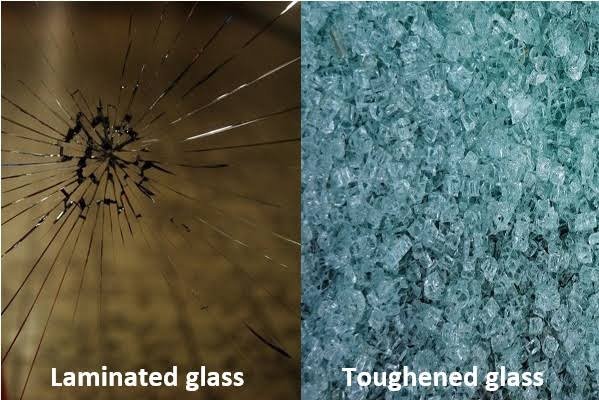
The most important difference between toughened and laminated glass becomes obvious only after something goes wrong. Toughened glass is designed to break into many relatively small granular pieces, while laminated glass is designed so that broken fragments remain held together by an interlayer.
Both are recognised forms of safety glass. In India, IS 2553 (Part 1):2018 covers safety glass for architectural, building and general uses and classifies safety glass into toughened (tempered) and laminated types.
For home windows, neither material is automatically better everywhere. Toughened glass is generally preferable when impact strength and heat resistance are priorities, while laminated glass is particularly useful when post-breakage retention, security and acoustic performance matter.
Toughened Glass vs Laminated Glass: Quick Comparison
| Feature | Toughened Glass | Laminated Glass |
|---|---|---|
| Construction | Heat-treated single glass | Two or more glass layers bonded with an interlayer |
| Impact strength | High | Depends on glass construction |
| Breakage | Small granular fragments | Fragments generally remain attached |
| Glass remains in opening after breakage | Usually no | Generally yes |
| Security after impact | Moderate | Better |
| Sound control | Standard | Can be better with suitable interlayer |
| UV reduction | Depends on product | Often better with suitable interlayer |
| Heat resistance | Good | Depends on glass combination |
| Processing after manufacture | Very limited | Depends on construction |
| Typical cost | Usually lower | Usually higher |
What Is Toughened Glass?
Toughened glass, also called tempered glass, begins as ordinary glass but undergoes controlled heating and rapid cooling.
This process creates compressive stresses at the surface, increasing its mechanical and thermal strength.
Industry guidance indicates that toughened glass can be around four to five times stronger than ordinary annealed glass of comparable thickness.
Its safety characteristic appears when it breaks.
Instead of forming large sharp shards like ordinary glass, toughened safety glass fractures into numerous relatively small granular pieces. BIS material similarly describes toughened glass as breaking into granular fragments without large jagged edges.
This makes it useful for areas where accidental human impact is a concern.
What Is Laminated Glass?
Laminated glass uses two or more pieces of glass bonded using an interlayer, commonly PVB (polyvinyl butyral) in conventional architectural applications.
The major advantage is what happens after breakage.
If one or both glass layers crack, the interlayer helps hold the fragments together instead of allowing the complete pane to immediately fall apart.
This provides a different form of safety from toughened glass.
A laminated pane can therefore remain substantially in place after breakage, helping maintain a temporary barrier until replacement is arranged.
It is important to remember that laminated glass itself can be manufactured using different glass combinations, including annealed, heat-strengthened or toughened glass.
1. Strength Against Impact
Winner: Toughened glass for basic mechanical strength
Toughened glass has a significant strength advantage over ordinary annealed glass of equivalent thickness because of the stresses introduced during tempering.
It can withstand substantially greater mechanical impact before breaking.
Laminated glass works differently.
Its main benefit is not necessarily that an individual glass layer is harder to break. Instead, its interlayer helps keep broken pieces together.
The exact strength of laminated glazing therefore depends on the type, thickness and number of glass layers used.
For example, laminated glass can itself be made using toughened panes where the application requires characteristics of both systems.
2. Safety After Breakage
Winner: Laminated glass where retention is important
This is perhaps the most important practical distinction.
When toughened glass fails, the entire pane generally fragments.
Although the resulting pieces are designed to reduce the risk associated with large sharp shards, the window opening may be left exposed.
Laminated glass behaves differently.
Its interlayer holds fragments in place, reducing the likelihood of broken pieces falling away and helping the glazing remain within the frame after breakage.
This can be particularly valuable for windows where retaining a barrier after breakage is important.
3. Security
Winner: Laminated glass
For security-focused residential glazing, laminated glass generally has the advantage.
Breaking a basic toughened pane causes it to fragment, potentially leaving an opening.
With laminated glass, the interlayer continues holding the broken glass together and makes immediate penetration more difficult. Pilkington notes that this retention can prevent a simple opening from being left after the glass breaks.
That does not mean every laminated pane is automatically “security glass.”
Different security requirements need appropriately tested glazing constructions, frames, locks and installation.
For accessible ground-floor windows, homeowners can ask the window supplier whether an appropriately specified laminated safety/security glazing system would be suitable.
4. Sound Insulation
Winner: Laminated glass, when properly specified
Homeowners living near busy roads, railway lines or other noisy environments often consider laminated glazing because the interlayer can help with acoustic performance.
However, sound insulation cannot be judged from the words “toughened” and “laminated” alone.
Performance depends on:
- Glass thickness
- Different pane thicknesses
- Interlayer type
- Insulating glass configuration
- Frame seals
- Installation quality
For serious noise problems, ask for the tested acoustic rating of the complete glazing system rather than relying on generic claims such as “soundproof glass.”
5. UV Protection
Winner: Laminated glass, generally
Suitable laminated glass can provide another useful benefit: filtering a substantial proportion of ultraviolet radiation.
This can help reduce UV exposure to furnishings, flooring, artwork and fabrics near windows.
Actual UV performance depends on the interlayer and product specification, so homeowners should request technical data rather than assume all laminated products perform identically.
Toughening by itself is primarily a safety and strength treatment; it should not be treated as an equivalent UV-control technology.
6. Heat and Thermal Performance
Winner: Neither automatically
“Toughened” and “laminated” describe safety-related glass construction, not complete thermal performance.
A window’s ability to control heat depends on other characteristics such as:
- Glass thickness
- Double or triple glazing
- Low-E coatings
- Solar-control coatings
- Air or gas spaces
- Frame design
- Window orientation
Toughened glass has good resistance to thermal stress, making it useful where glass experiences significant temperature differences.
Laminated glazing can also use heat-strengthened or toughened glass layers when necessary. BIS material recognises these different laminated configurations.
Therefore, someone trying to reduce summer heat should not simply ask for “laminated glass.” Solar-control and overall glazing specifications matter more.
7. Cost
Winner: Toughened glass, generally
Basic toughened glass is generally less expensive than comparable laminated constructions.
Laminated glass requires multiple layers plus an interlayer and an additional manufacturing process.
However, price comparisons need matching specifications.
Costs can change according to:
- Glass thickness
- Pane dimensions
- Interlayer
- Coatings
- Edge processing
- Toughening
- Lamination configuration
- Double-glazed construction
- Brand and processor
A laminated construction containing two toughened panes will naturally cost considerably more than a basic single toughened pane.
Obtain quotations based on the exact glass configuration required for the window.
8. Maintenance
Winner: Tie
Routine cleaning is broadly similar for both because the laminate is contained within the glass construction rather than exposed on the main faces.
The quality of manufacturing matters particularly with laminated glass. Poor processing or unsuitable edge exposure can create problems over time.
Both products should be installed using compatible framing, gaskets, sealants and appropriate edge protection.
Glass should also be inspected if it develops significant cracks or damage.
Which Glass Is Better for Different Home Areas?
Toughened glass can be suitable for:
- Windows where higher impact strength is required
- Shower enclosures
- Certain doors and partitions
- Areas exposed to thermal stress
- Applications where safe fragmentation is required
Laminated glass can be suitable for:
- Ground-floor accessible windows
- Windows where post-breakage retention matters
- Noise-sensitive rooms
- Certain overhead or fall-risk applications when appropriately specified
- Locations requiring improved security characteristics
Safety glazing is particularly important around doors, low-level glass and other locations where accidental human impact may occur.
The exact glass type and thickness should be selected according to window dimensions, location, loads and applicable building requirements rather than using one thickness throughout the house.
Can Glass Be Both Toughened and Laminated?
Yes—and this is an important point often missed in comparisons.
The choice is not necessarily either toughened or laminated.
Laminated safety glass can be produced using toughened glass layers. BIS technical material recognises laminated constructions incorporating annealed, heat-strengthened or toughened glass.
A toughened-laminated configuration can combine the increased strength characteristics of toughened panes with the fragment-retention characteristics of lamination.
Such constructions may be appropriate for demanding architectural applications, but they cost more and should be professionally specified.
What Should Indian Homeowners Check Before Buying?
Do not purchase safety glass based only on a verbal claim that it is “toughened” or “laminated.”
India’s current architectural safety-glass standard is IS 2553 (Part 1):2018, which was reviewed in 2024 and has subsequently received amendments. BIS lists architectural safety glass under mandatory certification.
Ask the supplier about:
- Applicable BIS compliance
- Manufacturer/processor
- Glass type
- Individual pane thickness
- Total laminated thickness
- Interlayer specification
- Required safety marking
- Edge processing
- Warranty
- Suitable frame and installation system
The safest and most economical specification can vary between a small bedroom window and a large floor-to-ceiling balcony glazing panel.
FAQs
Q1. Which is better for home windows, toughened or laminated glass?
A. Toughened glass is generally better where high mechanical strength and safe fragmentation are priorities. Laminated glass is preferable where retaining the broken glass in place, security or improved acoustic performance is important.
Q2. Which is safer if the glass breaks?
A. Both are safety-glass types but behave differently. Toughened glass breaks into relatively small granular fragments, while laminated glass uses an interlayer to retain broken pieces.
Q3. Is laminated glass stronger than toughened glass?
A. Not necessarily. Basic toughened glass has significantly higher mechanical strength than comparable ordinary annealed glass. Laminated glass’s key advantage is that its interlayer retains fragments after breakage. Laminated glass can also be manufactured using toughened panes.
Q4. Which glass is better for windows facing a busy road?
A. Properly designed laminated acoustic glazing can be useful for noise reduction. However, pane thickness, interlayer, insulating-glass construction, frame sealing and installation all affect actual sound performance.
Q5. Can I use toughened laminated glass for home windows?
A. Yes. Laminated glazing can incorporate toughened panes, combining different safety characteristics. Whether it is necessary depends on the window’s dimensions, location and performance requirements, so the final specification should be selected appropriately.