Books are not the only things that determine whether a bookshelf stays organised. Dust, sunlight, children, pets and the number of objects displayed alongside the books can completely change how practical a storage design feels after a few months.
An open bookshelf keeps everything visible and within immediate reach, making it excellent for frequently used books and decorative displays. A closed bookshelf adds shutters or glass doors, creating a protective barrier between the contents and the room.
For most homes, open bookshelves are better for easy access, display and a visually lighter design, while closed bookshelves are better for reducing dust, hiding clutter and protecting books that are stored for long periods. A combination of both is often the most practical solution.
Open vs Closed Bookshelf: Quick Comparison
| Feature | Open Bookshelf | Closed Bookshelf |
|---|---|---|
| Accessibility | Excellent | Good |
| Dust protection | Limited | Better |
| Visibility | Excellent | Depends on shutters |
| Display value | Excellent | Good with glass doors |
| Cleaning frequency | Higher | Lower inside |
| Visual appearance | Light and open | Neater and more contained |
| Hardware | Minimal | Hinges/sliding hardware required |
| Cost | Usually lower | Usually higher |
| Small rooms | Often suitable | Depends on design |
| Best for | Frequently used books | Protected/long-term storage |
What Is an Open Bookshelf?
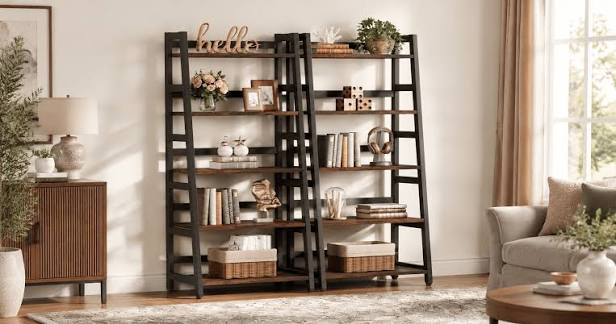
An open bookshelf consists of shelves without shutters or doors covering the front.
It may be a small freestanding unit, a wall-mounted shelf system or a large floor-to-ceiling bookcase.
Open shelves are commonly used for a combination of books and decorative items such as:
- Photographs
- Plants
- Artwork
- Collectibles
- Storage baskets
Their biggest advantage is visibility. You can immediately see what is stored and remove a book without opening anything first.
The trade-off is that the contents are directly exposed to the surrounding environment.
What Is a Closed Bookshelf?
A closed bookshelf adds doors or shutters in front of some or all of the shelves.
These may be made from:
- Glass
- Wood
- Plywood
- MDF or engineered board
- Metal
- Framed glass
Solid shutters completely conceal the contents, while glass doors preserve visibility while adding a physical barrier.
A closed bookcase can therefore function either as a protected display cabinet or as concealed storage depending on the shutter design.
1. Protection From Dust
Winner: Closed bookshelf
This is probably the strongest practical reason to choose closed storage.
Open shelves expose books directly to airborne dust.
Dust can settle on:
- Book covers
- Page edges
- Shelf surfaces
- Decorative objects
A large open library can consequently require regular cleaning.
Closed shelves significantly reduce the amount of dust reaching the contents, although they do not create an airtight environment.
Small gaps around doors still allow some dust to enter.
If you live close to a busy road, construction site or another environment where indoor dust is a frequent problem, closed storage can considerably reduce routine maintenance.
2. Easy Access
Winner: Open bookshelf
Open shelves require no extra step.
You see the book, reach for it and remove it.
This makes them particularly suitable for books that are used regularly, such as:
- School books
- Reference books
- Dictionaries
- Study materials
- Frequently read novels
- Children’s books
An open bookshelf beside a study desk can be especially convenient because commonly used material remains immediately accessible.
Closed shelves add a door that needs to be opened each time.
It is a minor inconvenience, but repeated use can make open storage noticeably easier.
3. Display and Decoration
Winner: Open bookshelf
An open bookcase can become part of the room’s visual design.
Books can be combined with carefully selected decorative objects to create an attractive feature wall.
It also gives more freedom to arrange items of different shapes and heights.
However, open shelves look best when they are reasonably organised.
Too many unrelated objects can quickly make them appear cluttered.
If the primary purpose is displaying an attractive book collection, open shelves or glass-fronted closed shelves are usually better than solid shutters.
4. Hiding Clutter
Winner: Closed bookshelf
Not every shelf remains perfectly arranged.
Books of different sizes, notebooks, documents, chargers and miscellaneous household items can make open storage visually busy.
Solid shutters solve this immediately.
Once the doors are closed, the room appears more organised even if the interior shelves are not perfectly arranged.
This makes closed bookshelves particularly useful in multipurpose rooms where the same cabinet needs to store both books and everyday items.
A combination design can work even better: attractive books remain visible while less presentable storage stays behind shutters.
5. Protection From Sunlight
Winner: Closed bookshelf with solid shutters
Repeated exposure to strong direct sunlight can fade book covers and other stored materials over time.
An open shelf near a sunny window provides little protection.
Solid cabinet shutters can block direct light when closed.
Glass doors are more complicated. Ordinary transparent glass allows the collection to remain visible but should not automatically be treated as complete protection against light-related fading.
For valuable books or items intended for long-term preservation, positioning the bookcase away from strong direct sunlight is sensible regardless of the door type.
6. Cleaning and Maintenance
Winner: Closed bookshelf for contents
An open bookshelf is mechanically simple, but its shelves and contents need more frequent dusting.
A closed bookshelf requires cleaning of:
- External shutters
- Handles
- Glass, if used
- Hinges or tracks
- Internal shelves occasionally
Although there are more components, the books themselves remain cleaner for longer.
Glass-fronted cabinets create an additional job because fingerprints and smudges can be visible on the doors.
For someone who dislikes repeatedly dusting individual books, closed storage usually wins.
7. Small Rooms
Winner: Open bookshelf, generally
Open shelving tends to look visually lighter because there are no large solid shutters covering the front.
A slim open bookcase can therefore work well in compact rooms.
Wall-mounted shelves can be even more space-efficient because they use vertical wall area without occupying a large footprint.
Closed cabinetry can feel visually heavier, particularly when dark floor-to-ceiling shutters are used.
That does not mean closed bookshelves should be avoided in small rooms. Light-coloured finishes, glass doors and carefully proportioned cabinetry can prevent the design from overwhelming the space.
8. Children’s Rooms
Winner: Depends on age and use
Open lower shelves can make books easy for children to see and access independently.
This can be useful for frequently read storybooks and school materials.
Closed sections, meanwhile, can store items that do not need to remain visible.
Whichever design you choose, stability matters more than the door type. Tall or heavy freestanding bookcases should be appropriately secured according to the manufacturer’s installation instructions so they cannot tip.
Avoid overloading upper shelves with unnecessarily heavy objects.
9. Cost
Winner: Open bookshelf
An open bookcase is generally simpler to manufacture.
It does not require:
- Shutters
- Hinges
- Handles
- Glass panels
- Door profiles
- Closing mechanisms
A closed bookshelf uses additional material and hardware, which normally increases cost.
Glass-fronted cabinets can become particularly expensive depending on the type of glass, frame and hardware selected.
However, material quality still matters. A premium solid-wood open bookcase can cost considerably more than a basic engineered-board closed cabinet.
Compare equivalent materials and dimensions.
10. Ventilation and Humidity
Winner: Open bookshelf for airflow
Open shelves naturally receive greater air circulation.
Closed cabinets restrict airflow, particularly when the doors remain shut for long periods.
This deserves attention in humid rooms.
A closed cabinet should not be installed directly against a wall with an unresolved dampness or seepage problem. Moisture can damage both the cabinet and books.
Before creating a large permanent bookcase, inspect the wall for:
- Damp patches
- Water leakage
- Mould
- Condensation
- Peeling paint
The source of moisture should be corrected first.
Which Bookshelf Is Better for Your Home?
Choose an open bookshelf if:
- Books are used frequently.
- Easy access is important.
- You want to display books and décor.
- The room needs a visually lighter design.
- You are comfortable dusting regularly.
- Budget is limited.
Choose a closed bookshelf if:
- Dust is a major concern.
- Books will remain stored for long periods.
- You want to conceal miscellaneous items.
- A cleaner visual appearance is preferred.
- The collection needs better protection from direct handling.
- You do not need instant access to every shelf.
For a study or reading area, open shelves around the desk can be extremely practical.
For a large collection that is not accessed every day, closed storage can reduce the cleaning burden considerably.
Consider a Combination Bookshelf
You do not necessarily have to choose one design for the entire unit.
A hybrid bookcase can provide the advantages of both.
For example:
- Open upper shelves: display books, photographs and décor.
- Glass-fronted shelves: display books while reducing dust exposure.
- Closed lower cabinets: store documents and miscellaneous items.
- Open shelves near a desk: keep frequently used books accessible.
This approach is especially effective for large living-room or study-room units.
Instead of asking whether the complete bookshelf should be open or closed, decide which items need display, which need quick access and which should remain hidden.
That usually produces a more practical storage design.
FAQs
Q1. Which is better, an open or closed bookshelf?
A. Open bookshelves are better for accessibility, display and frequently used books. Closed bookshelves are better for reducing dust, hiding clutter and protecting books stored for longer periods.
Q2. Do closed bookshelves prevent dust completely?
A. No. Doors significantly reduce dust entering the cabinet but normally do not make it airtight. Some dust can still enter through small gaps, so occasional internal cleaning is required.
Q3. Are open bookshelves good for a small room?
A. Yes. Open shelves can look visually lighter than large closed cabinets, and wall-mounted designs can use vertical space efficiently without occupying much floor area.
Q4. Are glass-door bookshelves better than open shelves?
A. Glass doors provide a useful compromise. Books remain visible while receiving better protection from dust and direct handling, although the glass itself requires regular cleaning.
Q5. Can I combine open and closed shelves in one bookcase?
A. Yes. A combination design is often the most practical choice. Frequently used or decorative books can remain on open shelves, while documents, less-used books and miscellaneous items can be stored behind closed doors.