Wardrobe doors influence more than the appearance of a bedroom. They determine how close a bed can sit to the wardrobe, how much of the storage can be accessed at once and even where mirrors, drawers and internal accessories can be positioned.
This makes the sliding-versus-hinged decision particularly important in Indian apartments, where bedroom floor space is often limited. Sliding wardrobes are generally better when there is limited clearance in front of the wardrobe or a wide contemporary storage unit is required. Hinged wardrobes are usually better for full access, simpler hardware, easier maintenance and budget flexibility.
Neither mechanism is universally superior. The room layout should make the decision.
Sliding Wardrobe vs Hinged Wardrobe: Quick Comparison
| Feature | Sliding Wardrobe | Hinged Wardrobe |
|---|---|---|
| Door movement | Slides sideways | Swings outward |
| Floor clearance needed | Minimal | More |
| Access to wardrobe | Partial at one time | Wider/full access |
| Small bedroom | Excellent | Depends on clearance |
| Very wide wardrobe | Excellent | Good |
| Hardware | Tracks and rollers | Hinges |
| Maintenance | Tracks/rollers need attention | Relatively simple |
| Mirror shutters | Excellent | Possible |
| Style | Contemporary | Versatile |
| Typical cost | Usually higher | Usually more economical |
What Is a Sliding Wardrobe?
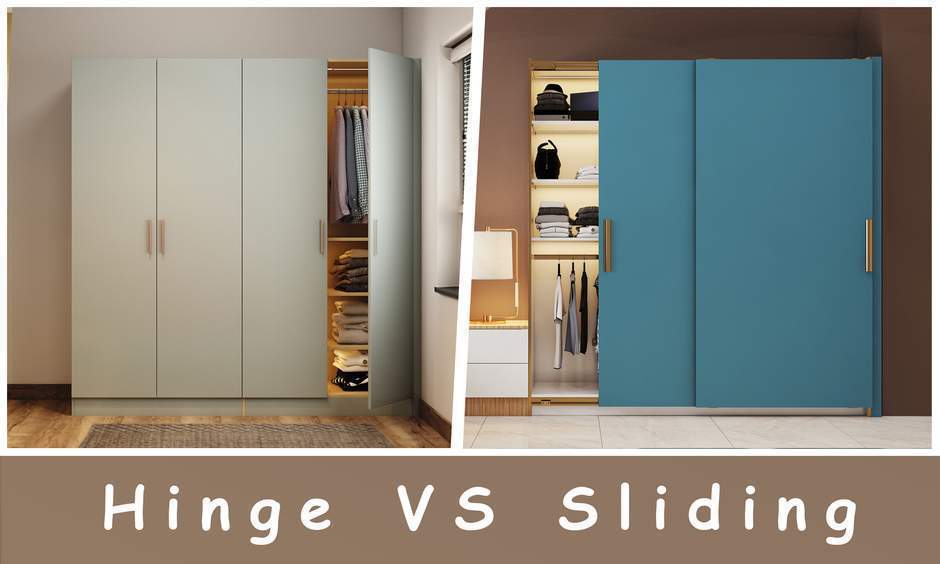
A sliding wardrobe uses two or more large shutters that move horizontally along tracks instead of opening into the room.
The doors overlap each other as they move.
This eliminates the swing space needed by conventional wardrobe doors, which can be particularly valuable when the bed, side table or other furniture is positioned close to the wardrobe.
Sliding systems can use several shutter finishes, including:
- Laminate
- Acrylic
- Glass
- Mirror
- Veneer
- Decorative panels
Large shutters can also create an uninterrupted contemporary appearance across an entire bedroom wall.
What Is a Hinged Wardrobe?
A hinged wardrobe uses conventional shutters attached to the wardrobe carcass with hinges.
The doors swing outward into the bedroom.
This is the traditional wardrobe arrangement, but modern concealed hinges and soft-close mechanisms make current systems much more refined than older designs.
Hinged wardrobes are highly flexible because they can be designed with narrow or wide shutters and adapted to unusual wall dimensions.
Their greatest functional advantage is simple: several doors can be opened simultaneously, giving the user broad access to the wardrobe interior.
1. Space Requirement
Winner: Sliding wardrobe
Sliding wardrobes are particularly useful when there is limited walking space between the wardrobe and the bed.
Because the shutter moves sideways, it does not require a large clear zone in front.
This can be valuable in:
- Small apartments
- Compact bedrooms
- Guest rooms
- Narrow rooms
- Rooms with large beds
A hinged wardrobe requires enough clearance for its doors to swing fully open.
If a bed or bedside table blocks that movement, everyday use can become frustrating.
However, sliding doors do not actually create more storage inside the wardrobe. Their advantage is that they use the surrounding floor space more efficiently.
2. Access to Clothes and Storage
Winner: Hinged wardrobe
This is the biggest functional disadvantage of sliding doors.
Because one sliding shutter moves in front of another, part of the wardrobe remains covered.
You normally cannot expose the entire width simultaneously.
With a hinged wardrobe, several shutters can be opened at once. This makes it easier to:
- Compare clothes
- Organise shelves
- Pack luggage
- Clean the wardrobe
- Reach multiple compartments
For someone who frequently reorganises clothes or wants everything visible at once, hinged doors are more convenient.
3. Small Bedrooms
Winner: Sliding wardrobe
Imagine a wardrobe installed opposite a double bed with only a narrow passage between them.
A large hinged shutter could occupy much of that passage when opened.
A sliding door does not.
This makes sliding wardrobes one of the most practical options for compact urban bedrooms.
But room dimensions should still be measured carefully. You need sufficient space to stand comfortably in front of the wardrobe and access its contents even if the door itself does not swing outward.
4. Internal Storage Flexibility
Winner: Hinged wardrobe
A hinged wardrobe provides more freedom when planning the internal layout.
Shelves, hanging sections and drawers can generally be positioned without worrying as much about which sliding panel will cover them.
Hinged shutters can also carry useful accessories such as:
- Small mirrors
- Tie holders
- Belt organisers
- Hooks
- Lightweight storage accessories
Sliding doors require greater coordination between the door positions and internal compartments.
For example, an internal drawer must be positioned so the sliding shutter can move far enough for that drawer to open properly.
Poor planning can result in a drawer colliding with the door or becoming difficult to access.
5. Large Wardrobes
Winner: Sliding wardrobe
Sliding systems work particularly well across broad wall-to-wall wardrobes.
Large panels create fewer visual divisions, giving the room a cleaner appearance.
A six- or eight-foot-wide wardrobe, for example, can sometimes be designed with a small number of broad sliding shutters rather than numerous narrow hinged doors.
However, large shutters are heavy.
The track, rollers, shutter material and profile must therefore be selected for the actual dimensions and weight.
A large sliding wardrobe should not use cheap hardware designed for lightweight shutters.
6. Mirrors
Winner: Sliding wardrobe
Full-height mirrors work particularly well with sliding shutters.
A mirrored sliding wardrobe can serve two functions:
- Provide full-length dressing mirrors.
- Make a compact room appear visually larger and brighter.
Because the shutter remains parallel to the wardrobe while moving, a large mirror does not swing into the room.
Mirrors can also be fitted to hinged shutters, but the hinge system needs to accommodate the additional weight and the door requires enough clearance to open safely.
In either design, appropriate safety considerations and proper installation are important for large glass or mirror panels.
7. Durability
Winner: Hinged wardrobe for mechanical simplicity
Both systems can last for years when good hardware is used, but hinged doors have a simpler operating mechanism.
A typical hinged shutter relies primarily on several hinges.
A sliding wardrobe depends on:
- Tracks
- Rollers
- Guides
- Profiles
- Stoppers
- Alignment
If the sliding hardware becomes misaligned or rollers wear, the shutter can become difficult or noisy to move.
Premium sliding hardware substantially improves performance, but it also increases the initial cost.
For long-term simplicity, hinged wardrobes have an advantage.
8. Maintenance
Winner: Hinged wardrobe
Hinges may occasionally require adjustment, especially if a shutter becomes misaligned.
However, replacement is usually straightforward when standard high-quality hardware has been used.
Sliding wardrobes require more attention to their movement system.
Dust and debris can accumulate in accessible tracks, while rollers and guides may eventually require adjustment.
Avoid forcing a sliding door that has suddenly become difficult to move. Continuing to push a misaligned heavy shutter can worsen the hardware problem.
Good installation at the beginning is particularly important.
9. Cleaning
Winner: Hinged wardrobe, slightly
The external shutters of either wardrobe are easy to clean according to their finish.
The difference is around the hardware.
Sliding tracks can collect dust and small debris and therefore need periodic cleaning.
Hinged wardrobes have no long floor-level sliding track.
The wardrobe interior is also easier to clean when multiple hinged doors can be opened simultaneously.
This is a small advantage, but it becomes noticeable over years of use.
10. Cost
Winner: Hinged wardrobe
For similar materials and dimensions, hinged wardrobes are generally more economical.
Quality hinges are relatively straightforward hardware.
Sliding systems require tracks, rollers, profiles and other components capable of supporting and moving large shutters reliably.
Premium sliding mechanisms can add significantly to the total wardrobe cost.
The final quotation also depends on:
- Plywood or board specification
- Wardrobe dimensions
- Shutter finish
- Mirror or glass
- Hardware brand
- Internal drawers
- Accessories
- Lighting
- Installation
When comparing quotations, ask for the exact hardware specification rather than accepting descriptions such as “premium sliding channel.”
11. Appearance
Winner: Depends on interior style
Sliding wardrobes naturally suit modern minimalist interiors.
Their broad shutters create clean horizontal movement and can make a wall look less visually fragmented.
Hinged wardrobes provide more design flexibility.
They work with:
- Contemporary interiors
- Traditional bedrooms
- Shaker-style shutters
- Panelled doors
- Laminate finishes
- Veneer
- Painted finishes
If you want a sleek floor-to-ceiling wardrobe with large mirrored or glass panels, sliding is particularly effective.
If you want decorative shutter detailing, hinged doors may offer greater freedom.
Which Wardrobe Is Better for Your Bedroom?
Choose a sliding wardrobe if:
- The bed is close to the wardrobe.
- Floor clearance is limited.
- You want large, clean-looking shutters.
- A full-height mirrored wardrobe is planned.
- The wardrobe is very wide.
- You prefer a modern appearance.
Choose a hinged wardrobe if:
- There is enough space for doors to open.
- You want access to several compartments simultaneously.
- Budget is important.
- Simple long-term maintenance is preferred.
- You want maximum flexibility for internal storage.
- Decorative door styles are part of the bedroom design.
For many compact apartments, sliding doors solve a genuine space problem.
For a bedroom with sufficient clearance, however, hinged wardrobes remain extremely practical and should not be rejected simply because sliding doors look more modern.
Measure the Bed-to-Wardrobe Distance First
Before selecting either style, measure the room after accounting for the actual furniture dimensions.
Check:
- Wardrobe depth
- Bed width and length
- Bedside tables
- Walking passage
- Hinged-door swing
- Bedroom entrance
- Internal wardrobe drawers
Also consider how the wardrobe will be used.
If two people regularly need different sections at the same time, a hinged wardrobe may provide easier simultaneous access.
For sliding wardrobes, make sure internal drawers and pull-out accessories align correctly with the door openings.
Good planning at this stage matters more than choosing whichever mechanism is currently fashionable.
FAQs
Q1. Which is better, sliding or hinged wardrobe?
A. Sliding wardrobes are generally better for bedrooms with limited space in front of the wardrobe. Hinged wardrobes provide better overall access, simpler hardware and greater flexibility at a lower typical cost.
Q2. Is a sliding wardrobe good for a small bedroom?
A. Yes. Sliding doors do not swing outward, so they work particularly well where the bed or other furniture is positioned relatively close to the wardrobe.
Q3. What is the main disadvantage of sliding wardrobes?
A. The main disadvantage is limited simultaneous access. Because the shutters overlap, one section of the wardrobe generally remains covered while another is open.
Q4. Which wardrobe requires less maintenance?
A. Hinged wardrobes generally have simpler hardware and require less maintenance. Sliding systems have tracks, rollers and guides that need to remain clean and properly aligned.
Q5. Are sliding wardrobes more expensive than hinged wardrobes?
A. They generally cost more when comparable cabinet and shutter materials are used because a good sliding wardrobe requires quality tracks, rollers and supporting hardware. The exact difference depends on wardrobe size, finish and hardware specification.