A kitchen sink can occupy exactly the same countertop width yet feel either spacious or cramped depending on how that space is divided. This becomes especially noticeable in Indian kitchens, where a sink may need to accommodate large kadais, pressure cookers, tawas and multiple utensils after a full meal.
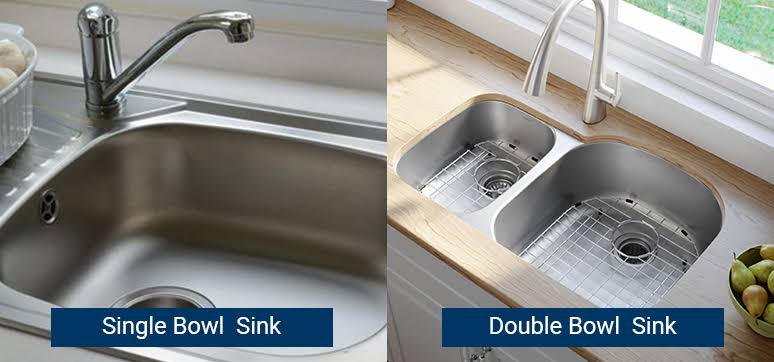
A single-bowl sink puts almost all available space into one uninterrupted basin. A double-bowl sink divides that area so two tasks can happen separately. A single bowl is generally better when you want maximum washing space and have a compact kitchen, while a double bowl is useful when you regularly separate washing, rinsing, soaking or food-preparation tasks.
The right choice therefore depends less on the number of bowls and more on how you actually use your kitchen.
Single-Bowl vs Double-Bowl Sink: Quick Comparison
| Feature | Single-Bowl Sink | Double-Bowl Sink |
|---|---|---|
| Number of basins | One | Two |
| Usable space per bowl | Larger | Smaller |
| Large utensils | Excellent | Depends on bowl size |
| Multitasking | Limited | Excellent |
| Small kitchens | Very suitable | Requires more space |
| Cleaning | Simpler | More corners/divider to clean |
| Plumbing | Simpler | Can be more complex |
| Counter space required | Usually lower | Usually higher |
| Installation cost | Often lower | Can be higher |
| Best for | Large cookware, compact kitchens | Task separation, larger kitchens |
What Is a Single-Bowl Sink?
A single-bowl sink contains one continuous basin without a central divider.
It can be compact enough for a small apartment kitchen or extremely large for a spacious countertop. The defining feature is that all available sink width is dedicated to one bowl.
This simple configuration is particularly useful when washing oversized cookware.
Instead of trying to fit a pressure cooker or large kadai into half of a divided sink, you can use the complete basin.
Single-bowl sinks are available in stainless steel, quartz composite and several other materials, as well as top-mount and undermount configurations.
What Is a Double-Bowl Sink?
A double-bowl sink contains two separate basins divided by a central section.
The bowls do not necessarily have to be equal.
Common configurations include:
- 50/50 equal bowls
- 60/40 bowls
- 70/30 bowls
- One deep bowl plus a smaller auxiliary bowl
This flexibility allows homeowners to choose a layout based on how they work.
One bowl might contain utensils soaking in water while the second remains available for rinsing vegetables. Alternatively, one side can be used for washing and the other for rinsing.
The trade-off is that dividing the sink reduces the uninterrupted space available for large items.
1. Washing Large Utensils
Winner: Single bowl
This is one of the strongest reasons to choose a single-bowl sink for an Indian kitchen.
Large pressure cookers, kadais, tawas and serving vessels can occupy considerable space.
A wide single basin makes it easier to place these items flat or partially inside the sink while cleaning them.
A double-bowl sink may have the same overall width, but the central divider reduces the dimensions of each individual basin.
If your household regularly uses large cookware, check the internal bowl dimensions rather than the overall sink dimensions shown in the catalogue.
2. Multitasking
Winner: Double bowl
A double-bowl sink becomes useful when several kitchen tasks need to happen at once.
For example, you can:
- Wash in one bowl and rinse in another.
- Soak utensils while keeping another bowl available.
- Wash vegetables separately from dirty dishes.
- Keep delicate items away from heavy cookware.
- Use one side for food preparation.
This separation can make kitchen work more organised.
It is particularly useful in households where the sink is continuously being used during cooking rather than only for washing dishes afterward.
A single-bowl sink can still support multiple tasks using accessories such as colanders and sink racks, but it does not provide the same physical separation.
3. Small Kitchens
Winner: Single bowl
Countertop space is valuable in a compact kitchen.
A single-bowl sink can provide a useful washing area without requiring the width associated with a large two-bowl design.
This makes it particularly practical for:
- Apartments
- Studio kitchens
- Small modular kitchens
- Utility kitchens
- Kitchenettes
A compact double-bowl sink is possible, but reducing the overall dimensions can make each individual basin too small to be genuinely useful.
One generously sized bowl is often preferable to two cramped ones.
4. Large Kitchens
Winner: Double bowl, depending on usage
When countertop and cabinet space are plentiful, a double-bowl sink becomes easier to justify.
You can choose a sufficiently wide model so that the primary bowl remains useful for larger utensils while the secondary bowl handles rinsing or preparation.
An unequal configuration such as 60/40 can provide a useful compromise.
The larger bowl handles cookware while the smaller one remains available for vegetables, cutlery or rinsing.
However, a large kitchen does not automatically require a double sink. Someone who mainly uses a dishwasher, for example, may prefer one large bowl even with plenty of available counter space.
5. Ease of Cleaning
Winner: Single bowl
A single-bowl sink has fewer internal edges and no central divider.
That means there are fewer areas where:
- Food residue can collect
- Water can remain
- Mineral deposits can develop
- Cleaning takes extra effort
The difference is not enormous, but it is noticeable during daily maintenance.
A double-bowl sink adds another set of internal corners and the central divider, all of which need wiping.
Sink shape also matters. Gently rounded internal corners are generally easier to clean than extremely sharp square corners.
6. Water Use
Winner: Depends on washing method
A double sink does not automatically save or waste water.
The result depends on how it is used.
Someone who fills one smaller bowl for washing and uses the second for rinsing may use water efficiently.
Someone who leaves the tap running continuously may not.
Similarly, a large single bowl does not need to be completely filled every time utensils are washed.
Therefore, choose a sink according to workflow rather than expecting the number of bowls alone to reduce water consumption.
7. Plumbing
Winner: Single bowl for simplicity
A single-bowl sink generally has a straightforward waste connection because there is only one drain outlet.
A double-bowl model usually requires the waste from both bowls to be connected correctly before reaching the drainage line.
This is normal plumbing work, but it introduces more:
- Connections
- Pipes
- Joints
- Space requirements
The difference becomes more important if the cabinet below the sink is also used for storage, a water purifier or another appliance.
Always check the under-sink layout before selecting a large double-bowl model.
8. Installation
Winner: Single bowl for simplicity
Installation depends significantly on the sink’s size, material and mounting method.
A compact stainless steel single bowl is relatively straightforward.
A large quartz-composite double bowl can be considerably heavier and may require stronger countertop support.
The sink also has to fit the base cabinet.
This is particularly important for undermount sinks because adequate support and correct sealing are essential.
Do not select a sink solely from its visible external width. Check the manufacturer’s required cabinet size and cut-out dimensions.
9. Cost
Winner: Single bowl, generally
A basic single-bowl sink is usually the more economical option because it can use less material and has a simpler configuration.
However, sink prices vary widely.
Cost depends on:
- Stainless steel or composite construction
- Steel thickness
- Overall dimensions
- Bowl depth
- Brand
- Surface finish
- Accessories
- Installation type
- Handmade or pressed construction
A premium handmade single-bowl stainless steel sink can cost considerably more than an entry-level double-bowl model.
Compare similar materials and quality levels when evaluating price.
10. Kitchen Appearance
Winner: Personal preference
Large single-bowl sinks suit minimalist kitchens particularly well.
Their simple uninterrupted form works naturally with modern countertops and undermount installations.
Double-bowl sinks have a more functional appearance, although modern low-divider and unequal-bowl designs can look equally sophisticated.
Sink material can influence the visual effect more than bowl configuration.
A black quartz-composite single bowl, for example, creates a very different appearance from a conventional stainless steel double bowl.
Which Is Better for an Indian Kitchen?
A single-bowl sink is generally the better choice if:
- You regularly wash large pressure cookers and kadais.
- Your kitchen is small.
- Maximum usable bowl space is important.
- You prefer simpler cleaning.
- You want straightforward plumbing.
- You use a dishwasher for many smaller utensils.
A double-bowl sink makes sense if:
- You regularly wash and rinse separately.
- You want to soak utensils without occupying the entire sink.
- Food preparation and dishwashing often happen simultaneously.
- Your kitchen has enough counter and cabinet space.
- You prefer separate work zones.
For many compact Indian apartments, one deep, adequately sized single bowl is often more practical than two small bowls.
For larger family kitchens where several tasks happen simultaneously, a 60/40 double-bowl configuration can offer a useful balance between large-utensil capacity and task separation.
What Size Should You Choose?
Do not decide based only on whether you want one or two bowls.
Measure:
- Sink base cabinet width
- Countertop depth
- Available countertop width
- Internal bowl dimensions
- Bowl depth
- Drain position
- Space below the sink
A deep bowl can hide dirty dishes and reduce splashing, but an excessively deep sink may be uncomfortable for some users because it requires more bending.
Also consider the faucet position. A large or divided sink needs a faucet with adequate reach so water can comfortably reach the required areas.
If you are installing a water purifier or waste system below the sink, include that equipment in your space planning.
Single Bowl or Double Bowl: Final Choice
There is no universal advantage to having more bowls.
The most useful sink is the one that matches your kitchen routine.
Choose single bowl for maximum uninterrupted space and simplicity. It is particularly useful for compact kitchens and households that frequently wash large cookware.
Choose double bowl for separation and multitasking. It becomes especially useful when washing, rinsing, soaking and food preparation regularly overlap.
Before ordering either design, place your largest frequently used kadai or pressure cooker on the countertop and compare its dimensions with the sink’s actual internal bowl size. That simple check can be more useful than comparing dozens of features online.
FAQs
Q1. Which is better, a single-bowl or double-bowl kitchen sink?
A. A single bowl is generally better for large cookware and compact kitchens, while a double bowl is better for households that frequently wash, rinse, soak or prepare food at the same time.
Q2. Is a single-bowl sink good for an Indian kitchen?
A. Yes. A large single bowl can be particularly practical in Indian kitchens because it provides enough uninterrupted space for pressure cookers, kadais, tawas and other large utensils.
Q3. What is the disadvantage of a double-bowl sink?
A. The main disadvantage is reduced individual bowl size. The central divider can make washing large cookware more difficult, especially when the overall sink width is limited.
Q4. Is a 50/50 or 60/40 double sink better?
A. A 50/50 design provides two equal work areas, while a 60/40 configuration gives one larger bowl for cookware and a smaller bowl for rinsing or preparation. For households using large utensils, 60/40 can be more practical.
Q5. Which sink is better for a small modular kitchen?
A. A sufficiently deep single-bowl sink is usually the more space-efficient choice. It provides maximum usable basin area without consuming the countertop and cabinet width required by a large double-bowl sink.